
Predictable IT costs means one fixed monthly fee per user that covers help desk, monitoring, cybersecurity, backup and planning, so a Canadian business can budget technology the way it budgets rent. I have led Fusion Computing since 2012. The question owners ask me most is rarely what IT costs today. It is what the number does in March, when three people join and a server fails in the same week.
This post sets out how the model works, what it covers, and where a fixed fee stops. Every figure below is anchored to a Canadian source you can open: the Canadian Centre for Cyber Security, Statistics Canada, Innovation, Science and Economic Development Canada, and the Office of the Privacy Commissioner. A brand claim is worth less than a regulator you can check.

KEY TAKEAWAYS
- Predictable monthly IT costs replace unpredictable emergency spending. That’s the core financial argument for managed IT.
- Statistics Canada measured the volatile half directly: Canadian recovery spending on cyber incidents doubled from roughly CA$600 million in 2021 to CA$1.2 billion in 2023, while planned prevention spending rose 13%.
- The Canadian Centre for Cyber Security recommends spending 4% to 7% of an IT budget on cyber security. A per-user fee makes that percentage knowable in advance.
- No per-incident charges and no surprise invoices. All-in pricing with a clear contract term and clean exit terms.
What Is Predictable IT Pricing, in Plain English?
According to the Canadian Centre for Cyber Security (2022), its Baseline Cyber Security Controls V1.2 targets organizations under 500 employees and recommends they spend 4% to 7% of the IT budget on cyber security. A percentage of a budget is only usable if the budget itself holds still. That is the whole argument for per-user pricing.
Predictable pricing means the invoice is a function of one variable you already track: headcount. Add a person, add a seat. The rate is agreed before the year starts, so a 14-person Hamilton firm knows its December IT line in January. Compare that with hourly billing, where the invoice is a function of how bad the month was.
The baseline document also frames the target as getting 80% of the benefit from 20% of the effort. In our practice that is exactly what a standardized per-user stack buys a small business: the controls that stop the common incidents, priced once, rather than a bespoke build quoted per project.
New Month, Same Cost
According to Statistics Canada (2024), business spending on recovery from cyber incidents doubled between 2021 and 2023. The release is Impact of cybercrime on Canadian businesses, 2023. Recovery spend went from about CA$600 million to CA$1.2 billion. Planned spending on prevention and detection rose far more gently, from CA$9.7 billion to CA$11.0 billion.
Read those two lines together and the case for a fixed fee stops being a sales point. The money a Canadian business plans to spend grew 13% across two years. The money it was forced to spend grew 100%. Recovery spending is the line no CFO forecasts, and it lands in whichever quarter the incident lands in.
Fusion Computing charges one agreed rate per user per month for the planned side of that picture. Recruitment, training, tooling renewals and after-hours call-outs sit inside the fee rather than arriving as one-off shocks. An emergency onboarding usually has the same shape. The environment was under-maintained for years, and the bill for catching up arrives all at once.
How Much Does Managed IT Cost Per User in Canada?
According to Microsoft (2026), Microsoft 365 Business Premium lists at CAD 29.80 per user per month on an annual commitment and CAD 35.76 billed monthly in Canada. That licence is one line inside a managed IT fee. Knowing it separately is the fastest way to sanity-check any quote you are handed.
Fusion Computing charges CA$185+ (typically ~CA$230) per user per month for fully managed IT services in Canada, covering 24/7 monitoring, help desk, cybersecurity, Microsoft 365, and backup. The company reports a 93% first-contact resolution rate with no per-incident surcharges.
The fee scales with seats rather than with incidents, and it carries a contract term with defined exit terms. For the full band-by-band breakdown, including what changes between 10 seats and 100, see our guide to managed IT services cost in Canada. Cybersecurity-only engagements run CA$185 to CA$230+ per user per month.
| Inside the fixed monthly fee. | Quoted separately. |
|---|---|
| Help desk and 24/7 monitoring. | Hardware refresh and replacement. |
| Patching and endpoint security. | Microsoft 365 licence fees. |
| Microsoft 365 administration. | Third-party SaaS subscriptions. |
| Backup and restore testing. | Cloud migrations and office moves. |
| Fractional CIO and CISO planning. | Net-new build projects. |
Expert Talent
According to Innovation, Science and Economic Development Canada (2025), 1,079,188 of Canada’s 1,099,521 employer businesses have fewer than 100 employees, which is 98.2% of them. Almost no Canadian employer is large enough to staff a full internal IT bench, and the arithmetic below is why.
An internal build means distinct hires with their own salary bands: a service technician, a network administrator, a security specialist and an IT manager. Each is a permanent payroll cost carrying benefits, training and turnover risk. A 40-person Vancouver company rarely has four roles of work. It has one role of work spread unevenly across four skill sets.
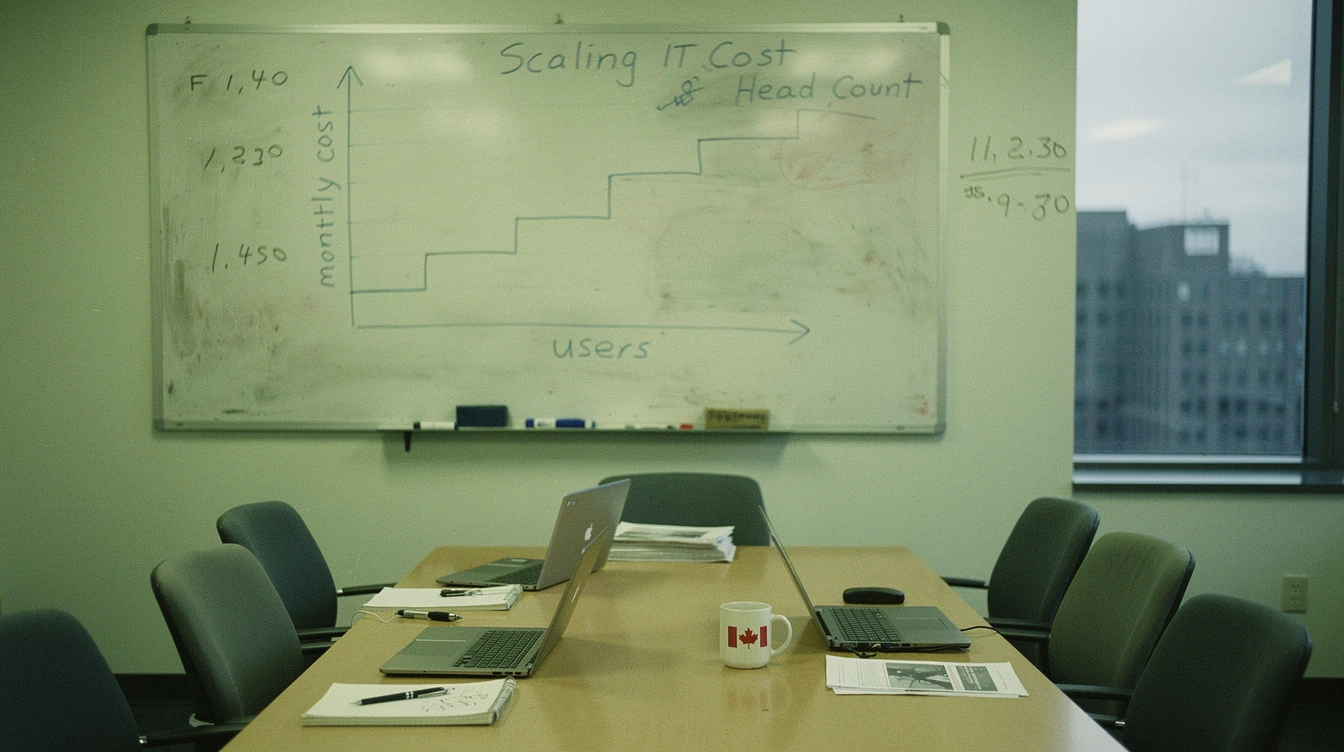
Under one agreed fee you reach senior technicians, IT strategists and security oversight without carrying 4 payroll lines. Strategy sits inside the same envelope through our virtual CIO and vCISO service. Where an internal person already exists, the same coverage layers on top through co-managed IT services instead of replacing them.
No Equipment = No Overhead
An internal team carries costs that never appear on a salary line: desk space, spare hardware, monitoring platforms, ticketing systems and licence renewals for tools nobody outside IT ever sees. Those are real money, they renew every 12 months, and they are the first thing an owner forgets when comparing a hire against a contract.
Fusion Computing operates remotely across Ontario and British Columbia, so the tooling that supports your environment sits inside the service agreement rather than on your balance sheet. You skip the platform licences, the monitoring stack and the replacement cycle on the equipment that runs them. When I price an internal build against a contract, this is the block owners have almost never costed.
Full-Stack IT Support
According to the Canadian Centre for Cyber Security (2024), its Ransomware Playbook sets a hard rule for backups. Hold 2 or more copies offline and unreachable from the network. Test restores on a schedule, monthly for example. That testing is labour which only happens when someone is paid to do it whether or not anything broke.
That is the practical difference between a reactive model and a managed one. Proactive monitoring, patching, security oversight, backup verification and disaster recovery planning all run on a calendar rather than on an incident. The same fee covers hardware lifecycle coordination and after-hours response, so 1 provider owns the outcome instead of 4 vendors owning fragments.
Fusion Computing’s monthly managed IT services package.
- All-inclusive, fixed per-user pricing.
- Executive IT strategy, delivered as a fractional CIO and CTO.
- Executive IT business operations, delivered as a fractional COO.
- Fractional CISO, with CISSP-led security oversight.
- Proactive 24/7 monitoring and support.
- 1-hour priority response on critical tickets.
“Fusion Computing has been the best IT Services provider we’ve ever had. Their managed IT services offering covers all 4 of our JP Motors locations bumper to bumper.”
Predictable Costs vs Hourly IT Billing: Where the Difference Shows Up
According to the Office of the Privacy Commissioner of Canada (2018), PIPEDA carries three breach duties. Report a breach posing a real risk of significant harm. Notify the affected individuals. Keep records of every breach for two years, including the ones that never met the reporting threshold. Record-keeping is continuous work, so an hourly model prices it as an extra.
Hourly IT invoices peak exactly when revenue is most at risk, during an outage or an onboarding crunch. A flat fee converts that peak into an operating expense you can forecast 12 months out. Our side-by-side comparison of the two billing models is in hourly IT vs managed services, and the internal-hire arithmetic is in the true cost of an internal IT department.

What a Fixed Monthly Fee Requires From Both Sides
According to the Canadian Centre for Cyber Security (2020), ITSM.50.030 tells buyers what a service level agreement must contain. It lists expected turnaround times, communication media, escalation processes, performance metrics and penalties for missing them. The same guidance states plainly that your organization remains the data owner and is legally responsible for data security.
A fixed fee is a two-sided agreement, so read the obligations that run back at you. You are expected to keep an accurate seat list, approve patch windows inside 5 business days, and let standard tooling be deployed everywhere rather than on the machines that felt convenient. Environments that carve out exceptions are the ones where a flat fee stops being economic for either party.
The Budget Checklist Before You Sign
According to the Canadian Centre for Cyber Security (2024), ransomware is the top cybercrime threat facing Canada’s critical infrastructure. That judgement comes from the National Cyber Threat Assessment 2025-2026, which adds that a wide range of Canadian businesses have been hit and no entity is immune. Price the contract against that, then work the list below.
- Is the rate per user or per device, and what counts as a user?
- What is the contract term, the notice period and the exit process for your data?
- Which response times are contractual, and what happens when they slip?
- Are backup restores tested on a written schedule, or only after an incident?
- Which licences are inside the fee and which are billed at cost?
- Who owns documentation of your environment when the relationship ends?
Work through that list against any 2 quotes and the cheaper headline number usually changes places. If you want a second pair of eyes on a quote you already hold, talk to our team and we will read it with you line by line. Budget sequencing is covered in our IT strategic planning process.
The IT Costs Calculator: Make Informed Decisions
Comparing an internal IT department against a managed contract is arithmetic, and most of the inputs sit in payroll rather than in an IT invoice. The Fusion Computing calculator therefore asks for salary bands first. Our IT operations cost calculator puts both columns side by side, so you can see the crossover point for your own headcount instead of accepting ours.
Managed IT services reduce costs in four ways. A fixed monthly fee replaces unpredictable hourly IT expenses. Proactive monitoring prevents costly downtime. The overhead of recruiting and retaining in-house IT staff disappears. Bulk licensing discounts land on your invoice. Most businesses save 30% to 50% against an equivalent level of support built internally.
Run your own numbers first, then bring them to a conversation. The figure I ask for first is never the monthly rate by itself. It is the monthly rate plus the 12-month variance of whatever you are doing today, which is the number most owners have never actually calculated. Our full small business IT budget guide shows where the rest of the spend goes.

Where to Start
I would start with paperwork. Pull 24 months of IT invoices and mark every line that surprised you. That total is the variance a fixed fee removes, and it is the honest basis for comparison. When you have it, get in touch and we will price the same scope against it.
Frequently Asked Questions
These are the 8 questions Canadian owners ask us most often about fixed-fee IT, drawn from quote conversations across Toronto, Hamilton and Metro Vancouver. Each answer carries a number you can check, and each one names what sits outside the fee as clearly as what sits inside it.
How does predictable IT pricing benefit my business financially?
Predictable pricing removes budget surprises. Instead of absorbing unexpected repair bills, emergency support fees or infrastructure replacement costs, you pay a fixed monthly amount per user. Statistics Canada measured why this matters: Canadian business spending on recovery from cyber incidents doubled to CA$1.2 billion in 2023, and recovery spend lands in whichever quarter the incident lands in.
What does scalable IT support mean in practice?
Scalable support means service grows with headcount without a renegotiation or a hiring cycle. Add 5 users in March and the next invoice reflects 5 more seats at the agreed rate. The provider already holds the capacity and tooling to absorb that. In-house IT works the other way, because headcount lags demand by the length of a hiring process.
What is included in Fusion’s all-inclusive monthly managed IT fee?
The package covers proactive 24/7 monitoring and support, patch management and Microsoft 365 administration. It also carries fractional CIO and CISO leadership, vendor management, security oversight, backup verification and disaster recovery planning. Critical tickets carry a 1-hour priority response. Hardware refresh, Microsoft licences, third-party SaaS and project work such as cloud migrations are quoted separately.
How does Fusion handle equipment and infrastructure costs without on-site overhead?
Fusion Computing operates remotely, so no office space or dedicated hardware is allocated to your account. The monitoring platforms, ticketing system and management tooling used to support your environment are inside the service fee. That removes the capital cost of equipping and housing an internal IT function, which is typically the largest non-salary line in an in-house budget.
Can managed IT pricing really match what I would spend on one IT hire?
For many businesses between 20 and 80 seats, yes. A mid-level IT hire costs CA$70,000 to CA$100,000 in salary alone, before benefits, training and turnover. A managed package in that range provides a full team with deeper specialist coverage, 24/7 monitoring and strategic leadership. Use the IT operations cost calculator to compare your own numbers.
How much do managed IT services cost per user per month in Canada?
Fusion Computing charges CA$185 or more per user per month for fully managed IT, with most Canadian engagements landing near CA$230. Cybersecurity-only scopes run CA$185 to CA$230+ per user per month. For reference, Microsoft lists Microsoft 365 Business Premium at CAD 29.80 per user per month on an annual commitment, which is one licence line inside that fee.
What is not covered by a fixed monthly managed IT fee?
Five things sit outside the fee and should be quoted separately: hardware refresh, Microsoft and third-party licence costs, net-new build projects, office moves and cloud migrations. Naming them in the agreement is what keeps the monthly number stable. The Canadian Centre for Cyber Security recommends the service level agreement also specify turnaround times, escalation paths and performance metrics.
What contract term does Fusion Computing use, and how does exit work?
Engagements carry a defined contract term rather than an open-ended arrangement, because the onboarding work in the first 90 days is front-loaded. The agreement sets the notice period, the handover process and how environment documentation is returned to you. Under PIPEDA your organization stays the data owner throughout, so exit terms should be read before signature.
Reviewed by Mike Pearlstein, CISSP, CEO of Fusion Computing. I have led Fusion’s managed IT and cybersecurity practice since 2012, serving Canadian businesses across Toronto, Hamilton and Metro Vancouver. Fusion Computing was named one of Canada’s 50 Best Managed IT Companies in 2024. Our security oversight is CISSP-led, and we publish what sits inside and outside the fee so a finance team can audit it.
Ready to talk IT for your business?
Fusion Computing has supported Canadian SMBs since 2012. 93% first-contact resolution, CISSP-led team, fixed-price contracts.
Related Resources
Book a consultation with Fusion Computing and we will price your current scope against a fixed monthly fee.
Last reviewed: August 2026. Fusion Computing