
At Fusion Computing, technology work runs on people and on measured results. Our membership in The ASCII Group, an independent, peer-led MSP community, is one of the ways that shows up in client work. Being part of that network lets Fusion test tools and practices against the experience of peers across the continent, so the IT support we deliver stays practical and fitted to your business.

KEY TAKEAWAYS
- Fusion’s network advantage comes from the tools, the team, and the peer community working together.
- Monitoring and endpoint security run on one integrated platform set rather than bolted-on point products.
- Fusion Computing’s first-contact resolution rate is 93 percent.
- Peer benchmarking is what tells us when our own numbers are drifting.
Mike Pearlstein is CEO of Fusion Computing and holds the CISSP. He has led Fusion’s managed IT and cybersecurity practice since 2012, serving Canadian businesses across the GTA, Hamilton and Metro Vancouver.
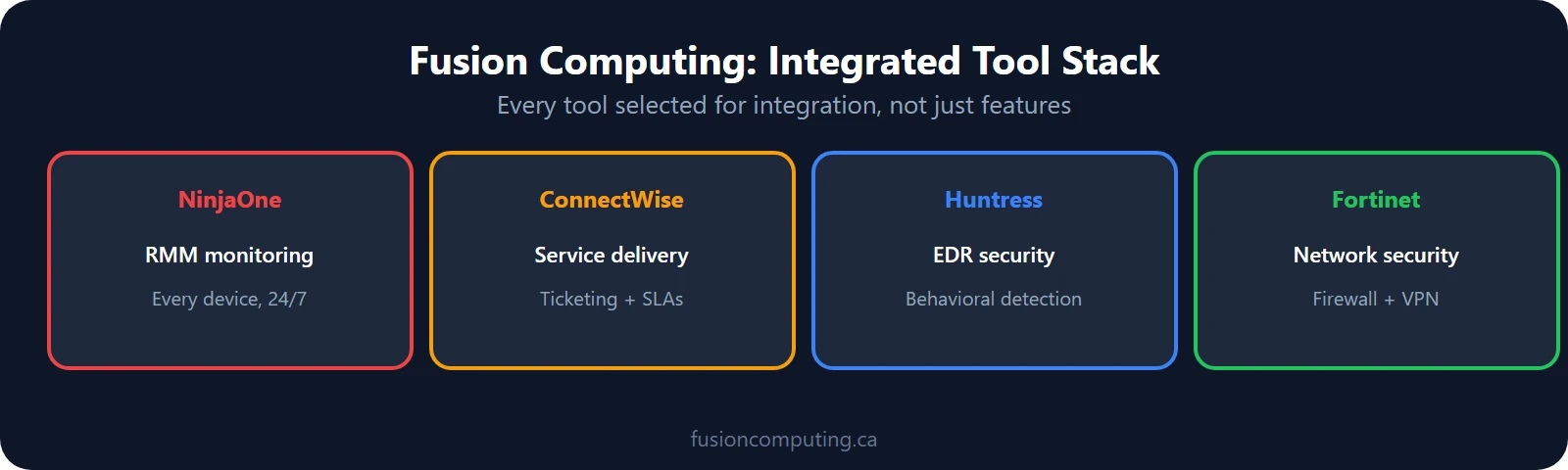
Fusion Computing’s network advantage comes from an integrated platform set where every tool is chosen for how it works with the others: remote monitoring and patching, one service-delivery and ticketing system, then behavioural endpoint detection layered on managed network security. Our first-contact resolution rate is 93 percent, backed by 24/7 coverage.
The rest of this page explains where that comes from, what our peer community actually changes about a Tuesday-afternoon decision, and what our clients tell us they notice after a few months.
A Community That Works for You
According to Statistics Canada (2024), about 1 in 6 Canadian businesses (16 percent) were impacted by a cyber security incident in 2023. Recovery spending doubled to roughly CA$1.2 billion that year, while prevention and detection spending reached CA$11.0 billion across 12,462 surveyed enterprises.
Smaller Canadian firms absorb that pressure with the leanest internal teams. I have yet to meet a 40-person manufacturer in Hamilton with a threat analyst on staff. What that business can do is borrow the pattern recognition of people who see the same problems every week.

A managed network is a service where an IT provider deploys, monitors and maintains your business network infrastructure, including switches, routers, firewalls, wireless access points, and VPN connections, under a fixed monthly agreement that usually includes 24/7 monitoring. The provider handles firmware updates and security hardening so your team can focus on running the business.
Running IT for a growing business is unpredictable work. Fusion’s connection to ASCII means our clients do not face that alone. The community is made up of MSP owners and engineers across North America who compare notes on what actually worked in the last 12 months, and we bring those answers into client environments directly.
Every recommendation we make has usually been pressure-tested somewhere else first. In our practice that is the difference between an opinion and a decision, and it is why we can tell a client which of 2 reasonable options tends to age badly.
Guidance You Can Trust
According to the Canadian Centre for Cyber Security (2025), organizations with fewer than 499 employees should implement 13 baseline controls, an 80/20 approach designed to capture most of the benefit for a fraction of the effort. That list is where most of our guidance conversations start.

Technology moves quickly, and businesses need IT partners who keep pace. ASCII membership gives Fusion access to a wide range of expertise across cybersecurity services and infrastructure planning, which we apply directly to client projects.
The practical version: when a client asks me whether a control is worth the money, I can answer with what it actually prevented at a business of similar size in Toronto or Hamilton, rather than with a vendor datasheet.
Growth That Goes Beyond Numbers
According to the Center for Internet Security (2024), CIS Controls v8.1 adds explicit guidance for hybrid and fully cloud environments and for supply-chain security management. We map client roadmaps to that version so the growth plan and the security plan stay one document.
ASCII membership keeps us close to what is changing, and we apply that to every engagement through virtual CIO planning. Whether the work is adopting new tools or tightening security, the goal is the same: fewer surprises in the next 12 months.
We went from 35 to 70 employees in under a year. Every new hire needed a laptop, accounts, and security configured within 48 hours. Fusion handled every onboarding without us having to micromanage it.
Priya R., Fusion Computing client
One Vision
According to the Office of the Privacy Commissioner of Canada (2018), organizations under PIPEDA must report breaches that pose a real risk of significant harm, notify affected individuals as soon as feasible, and keep records of every breach for at least 24 months.
Trust and collaboration define the ASCII community, and those values also define how my team works with clients. In my experience the habits of a peer group show up most clearly during a bad week, on the 2 a.m. ransomware call rather than the quarterly review.
When something breaks, we bring the collective experience of the community into the fix rather than working from one technician’s last project. If you want that applied to your Toronto or Hamilton environment, talk to our team.
How the network changes everyday IT decisions
According to the Canadian Centre for Cyber Security (2025), ransomware is one of the most disruptive forms of cybercrime facing Canada, threat actors are largely opportunistic rather than industry-specific, and no organization is immune. Peer intelligence is how a smaller provider keeps pace with that.
The network matters most when a client needs a decision, and that is the call I take most often. A vendor says a tool is best. A project is stuck between 2 good options. A small internal team needs to know whether to standardize, switch, or keep what already works.
In those moments we compare what we see in the field with what other MSPs are seeing across North America, then narrow the choice to the options that fit the business. That saves time, and it removes a lot of expensive guesswork.
That help matters most when a company is growing faster than its IT habits. A 15-person single-server office has different needs than a 3-site business juggling remote users and a stack of vendor relationships.
The network helps us separate the obvious fixes from the changes that create more work later. It also shows where a process change beats a purchase. Often the answer is a clearer operating model rather than a new platform.
Continuity gets easier too. If a client’s internal IT lead is out for 2 or 3 weeks, we are not starting from zero. We already have context, and the community behind us shortens the trial-and-error phase.
That applies to escalation paths, PIPEDA record-keeping, and choosing between fully managed IT and a more collaborative co-managed IT model. The right answer varies by business, and it should be an informed one.
The Fusion Advantage Across North America
According to Innovation, Science and Economic Development Canada (2023), the CyberSecure Canada certification program transferred to the Standards Council of Canada on March 31, 2023. Knowing which body actually certifies a program is the kind of detail a peer network surfaces early.

Through ASCII, Fusion delivers consistent IT support to businesses across Canada and the United States. The value to you is faster problem-solving, plus service informed by the experience of many MSP leaders rather than one.
What clients notice after a few months
According to the Canadian Centre for Cyber Security Ransomware Playbook (ITSM.00.099), organizations should keep 2 or more backups offline and unreachable from the network, with a secondary copy in the cloud, and should test restores regularly. Peer incident reports are what turn that advice into a scheduled task.
Early on, the network mostly changes how decisions get made. What I hear from clients around the 3-month mark is different: less churn. Fewer repeated tickets. Fewer one-off purchases that do not fit the environment. More predictable support.
That happens because we can compare a client environment against what 3 or 4 peer MSPs are running, then fold the useful lessons into our own standards. If a practice is helpful and repeatable, we keep it. If it is merely popular, we skip it.
Security planning gets the same treatment, with references like CIS Controls v8.1 keeping the conversation grounded in something specific. We stay practical about what to standardize now, what can wait, and what would add overhead without making the business safer.
That is the real benefit of the network. It gives us more signal to work with, and it does not replace judgment. Clients across Toronto, Hamilton, and Metro Vancouver still get human advice and a plan that fits how the business actually runs. If that is the kind of partner you want, talk to our team.
Fusion Computing is a Canadian-owned managed IT and cybersecurity provider serving businesses with 10 to 150 employees since 2012. With a 93 percent first-contact resolution rate and CISSP-led security leadership, Fusion delivers monitoring, help desk, and security services aligned to CIS Controls v8.1 across Toronto, Hamilton, and Metro Vancouver.
Partner with Fusion Today
Working with Fusion gives you IT expertise plus a continent-wide peer network behind every recommendation. If you want a second opinion on a vendor decision or a look at your current setup, contact us. I read every one of those.
Frequently asked questions about the Fusion network
What is The ASCII Group and why does it matter?
The ASCII Group is an independent, peer-led community of managed service providers across North America. Members share vetted vendor relationships, incident playbooks, and benchmark data. For clients of a member MSP like Fusion Computing, it means your provider draws on the experience of hundreds of peer practitioners rather than only its own last 12 months of projects.
How does Fusion Computing’s ASCII membership benefit its clients?
Membership gives Fusion access to peer-tested strategies and preferred vendor programs that pass through to clients. When a new challenge appears, we can draw on peers who have already faced it. That shortens the diagnosis phase and is 1 reason our first-contact resolution rate is 93 percent.
What types of expertise does Fusion’s network connection provide?
The community includes specialists in cybersecurity, infrastructure, cloud services, compliance, and business strategy. Fusion taps that expertise for specific client challenges and benchmarks its own practices against other MSPs. Clients get access to 5 broad specialist areas without engaging 5 separate vendors.
How does belonging to a trusted MSP community improve service quality?
Peer accountability raises standards. Members share performance data and lessons from failures, so improvements spread across the group. Clients benefit because their provider is continuously compared against others rather than grading its own homework. We review our core service metrics against peer benchmarks 4 times a year.
What is a managed service provider (MSP) and what services do they provide?
An MSP proactively manages a defined set of IT services for a fixed monthly fee. Services commonly include network monitoring, cybersecurity, help desk, backup and disaster recovery, server management, and IT strategy. Unlike hourly IT, an MSP carries the cost of every incident, which aligns its incentives with 24/7 uptime.
How does Fusion Computing use network insights to help clients grow?
We apply community insight to vendor evaluations and security strategy. Recommendations come from real outcomes at comparable businesses rather than theory. Most of our clients sit between 10 and 150 employees, so the comparison set is genuinely similar to their environment.
How much does Fusion Computing’s managed IT cost per user per month?
Fully managed IT starts at CA$185+ per user per month. Co-managed IT, for businesses that already employ internal IT staff, starts at CA$160+ per user per month. Cybersecurity-focused engagements run CA$185 to CA$230+ per user per month depending on endpoint count and regulatory exposure under PIPEDA or PHIPA. Every proposal names the scope and the SLA in writing.
Is Fusion Computing an MSP or an MSSP?
Both, and they are the same engagement from our side. Fusion delivers managed IT and managed security under 1 contract with 1 accountable team, rather than splitting them across 2 vendors. Security oversight is CISSP-led and mapped to CIS Controls v8.1. If you need only the security layer, that scope can be priced on its own.
Last reviewed: August 2026. Fusion Computing
Fusion Computing serves Canadian businesses across:
IT Support Toronto · IT Support Hamilton · IT Support Metro Vancouver