
A managed security service provider (MSSP) is a third-party company that provides 24/7 cybersecurity monitoring, threat detection, incident response, and compliance management for businesses that don’t have an in-house security operations center. In Canada, MSSPs typically charge $30–$80 per user per month on top of managed IT, or $180–$250 per user all-in when bundled with full MSP services.
Most companies don’t need another cybersecurity acronym. They need to know who is watching when a suspicious login hits at 1:43 a.m., who investigates it, and who can contain it before it becomes a business problem.
That’s the job of a managed security service provider (MSSP).
A managed security service provider — MSSP stands for Managed Security Service Provider — is a third-party partner that continuously monitors your environment, detects and investigates threats, helps contain incidents, and gives you access to security operations without forcing you to build a 24/7 in-house team. That matters because the Cyber Centre’s National Cyber Threat Assessment 2025-2026 says ransomware is the top cybercrime threat facing Canada’s critical infrastructure, and Statistics Canada reports that Canadian businesses spent $1.2 billion recovering from cybersecurity incidents in 2023.
In this guide, I will walk through what an MSSP actually does, how it differs from an MSP, what Canadian privacy and cyber rules matter, and how to choose a provider without getting lost in vendor buzzwords.
The goal is to make the buying process clearer before you compare MSSPs, MDR vendors, or internal security models.
KEY TAKEAWAYS
- An MSSP (Managed Security Service Provider) specializes in cybersecurity: threat monitoring, incident response, and security compliance.
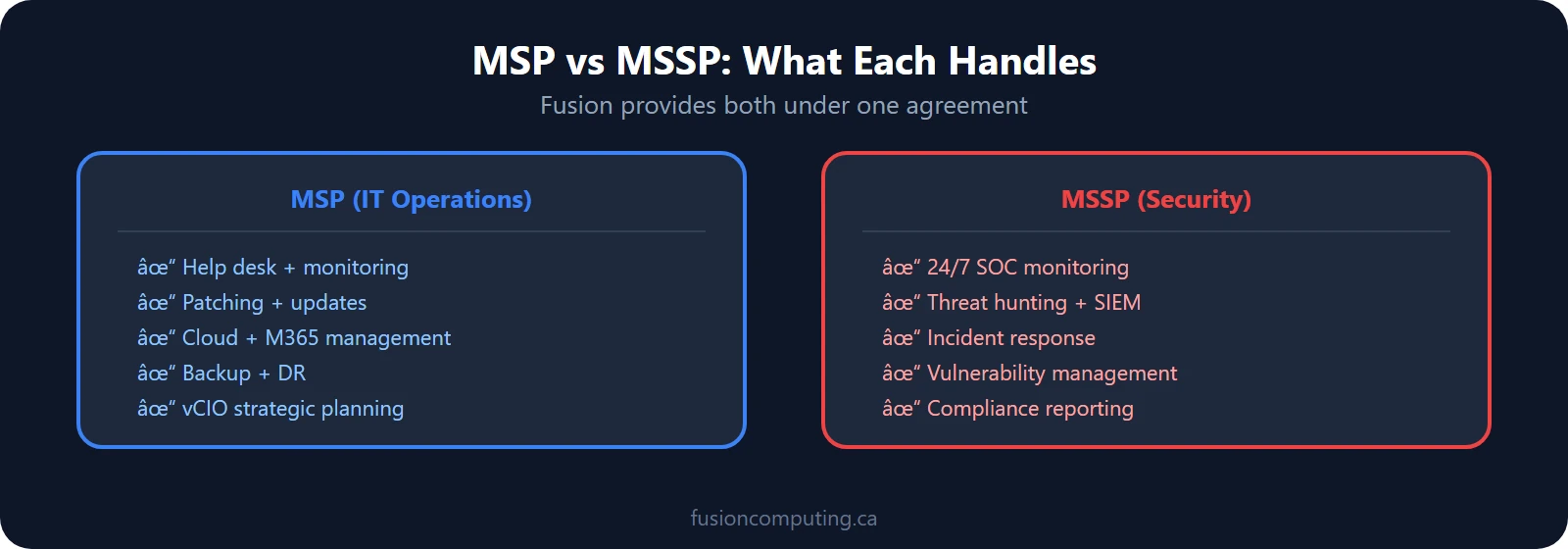
- MSP handles IT operations. MSSP handles security specifically. Many modern providers (like Fusion) do both under one agreement.
- Dedicated MSSP services cost $30–$80/user/month on top of IT management. All-in bundles at $180–$250/user are usually more cost-effective.
Table of contents
- The simplest definition
- What an MSSP actually does day to day
- MSP vs. MSSP: where businesses get this wrong
- MSSP vs. MDR: where the lines blur
- Why Canadian businesses are paying more attention to MSSPs
- The Canadian compliance piece, in plain English
- Why we use CIS Controls as a baseline
- How to tell a real MSSP from a company using the label
- Red flags to watch for
- When it’s time to engage an MSSP
- How Fusion Computing approaches managed security
- Frequently Asked Questions
- Sources referenced in this guide
The simplest definition
If an MSP keeps your systems running, an MSSP keeps them defended.
Fusion Computing is a Canadian-owned managed IT and cybersecurity provider serving businesses with 10 to 150 employees since 2012. With a 93% first-contact resolution rate and CISSP-certified security leadership, Fusion Computing delivers monitoring, help desk, and security services aligned to CIS Controls v8.1.
A good MSSP does more than send alerts. It helps you see what is happening across endpoints, identities, email, cloud platforms, firewalls, and networks, then turns that visibility into action. That usually includes monitoring, threat detection, triage, incident response support, vulnerability management, and executive-level reporting.
What an MSSP actually does day to day
In practical terms, core MSSP services include some mix of:
- 24/7 monitoring of logs, endpoints, identities, cloud activity, and perimeter controls
- Threat detection and response, often through MDR, EDR, XDR, SIEM, or a combination
- Incident investigation and containment when something suspicious turns out to be real
- Vulnerability scanning and remediation prioritization, so the most dangerous gaps get closed first
- Security reporting for leadership, auditors, insurers, and clients
- Strategic guidance, whether that’s a formal vCISO service or a lighter recurring security review
The important point isn’t the acronym stack. It’s whether someone is genuinely watching, genuinely triaging, and genuinely empowered to act.
MSP vs. MSSP: where businesses get this wrong
This is one of the biggest misconceptions I see.
A traditional MSP usually focuses on availability, user support, patching, backups, device management, Microsoft 365 administration, and keeping day-to-day IT stable. Those are critical services. They aren’t the same thing as security operations.
An MSSP focuses on detecting suspicious activity, understanding whether it matters, and helping contain it before it spreads. That includes things like unusual sign-in patterns, privilege escalation, lateral movement, data exfiltration, and the messy middle of an incident where someone needs to decide what is noise and what is an actual breach.
Teams also confuse frontline service desk work with broader support ownership, which is why this breakdown of help desk vs. IT support services is useful before comparing providers.
| Dimension | MSP | MSSP |
|---|---|---|
| Primary focus | Uptime, productivity, infrastructure stability | Threat detection, incident response, risk reduction |
| Core tooling | RMM, PSA, backup platforms | SIEM/SOAR, EDR/XDR, threat intelligence, vulnerability scanners |
| Operations centre | NOC (Network Operations Centre) | SOC (Security Operations Centre) |
| Staffing | Help desk, sysadmins, network engineers | Security analysts, incident responders, threat hunters |
| Compliance role | Implements controls such as encryption and access policies | Maps controls to frameworks, provides audit evidence, monitors drift |
| When an alert fires | May see it, may escalate, may lack triage context | Correlates with telemetry, determines severity, contains and initiates incident response |
Most growing businesses need both functions. Sometimes that means two separate partners. Sometimes it means one provider with clearly separated IT operations and security teams — a model often called co-managed IT. Either model can work. What doesn’t work is assuming that antivirus, patching, and a firewall add up to a complete security program.
Evaluation lens: separate monitoring, investigation, containment authority, and reporting when you compare MSSP providers.
MSSP vs. MDR: where the lines blur
Another distinction worth clarifying: MDR, or Managed Detection and Response. MDR is a focused service centred on active threat hunting, investigation, and hands-on incident response. An MSSP typically provides a broader set of managed security services that includes MDR capability alongside vulnerability management, compliance support, firewall management, security reporting, and strategic guidance.
Think of MDR as one layer within a full MSSP engagement. Many providers offer MDR as a standalone product, and many MSSPs include MDR as part of their managed security services. For Canadian SMBs, the question that matters most isn’t which acronym your provider uses. It’s whether they can actually detect a real threat after hours, investigate it with context, and contain it before it becomes a business problem.
Many MSSPs use MDR tooling as one component within a broader security operations model aligned to a framework such as CIS Controls. The important question is whether the provider can translate tooling into monitoring discipline, investigation quality, and containment authority.
Why Canadian businesses are paying more attention to MSSPs
There are three reasons this conversation has shifted from optional to urgent.
The threat environment isn’t settling down. The Cyber Centre’s National Cyber Threat Assessment 2025-2026 identifies ransomware as the top cybercrime threat facing Canada’s critical infrastructure. Statistics Canada reported that 13 percent of businesses impacted by cyber incidents experienced ransomware in 2023. That’s enough to make monitoring, backup discipline, and response readiness part of day-to-day operations.
The financial impact is real. Statistics Canada reports that Canadian businesses spent $1.2 billion on cyber incident recovery in 2023, up from roughly $600 million in 2021. IBM’s 2025 Canada breach findings put the average Canadian breach at CA$6.98 million, a 10.4 percent increase year over year. Phishing was the most common initial attack vector, costing an average of CA$7.91 million per incident. On the same IBM data, organizations using security AI and automation extensively averaged CA$5.19 million per breach, versus CA$8.53 million for organizations not using them.
This is increasingly a Canadian procurement issue. In CIRA’s 2025 vendor-selection release, 82 percent said country of origin matters more than it did a year earlier, and 56 percent said they had reconsidered U.S.-based providers due to trade and political uncertainty. For businesses evaluating MSSPs, that means questions about where logs are stored, who can access them, and whether the provider can support Canadian data residency expectations are now part of the buying process.
The Canadian compliance piece, in plain English
Compliance information last reviewed: March 2026. For any managed security service provider operating in Canada, understanding the regulatory landscape is essential. Regulatory status may change. This article is general information, not legal advice.
PIPEDA
At the federal level, PIPEDA applies to private-sector organizations across Canada that collect, use, or disclose personal information in the course of commercial activity. Alberta, British Columbia, and Quebec have private-sector laws considered substantially similar for activities occurring within those provinces.
If compliance pressure is driving the conversation, start with a practical cybersecurity risk assessment before you buy more tools.
From a security operations standpoint, the practical issue is breach handling. If a breach creates a real risk of significant harm, organizations subject to PIPEDA must report it to the Office of the Privacy Commissioner of Canada, notify affected individuals, and keep records of all breaches for at least two years.
That’s one of the clearest reasons to work with a real MSSP instead of a loose collection of tools. You need logging, evidence, incident triage, a clean timeline, and a repeatable process when something goes wrong.
Quebec’s Law 25
If you handle personal information in Quebec, the bar is higher. Under Quebec’s Act respecting the protection of personal information in the private sector, Law 25 requires privacy impact assessments for projects that involve acquiring, developing, or overhauling information systems involving personal information. It also requires an assessment before communicating personal information outside Quebec, prompt notice to the Commission d’acces a l’information and affected individuals when an incident presents a risk of serious injury, and a register of confidentiality incidents. Administrative monetary penalties can reach $10 million or 2 percent of worldwide turnover, with penal fines up to $25 million or 4 percent of worldwide turnover.
For an MSSP, that means support needs to go beyond sending an alert. It should include evidence handling, incident documentation, response guidance, and a clear understanding of how monitoring ties back to privacy obligations.
Bill C-8
Bill C-8 matters, but it needs to be described accurately.
As of March 2026, Bill C-8 has been reported back to the House after committee study and isn’t yet law. It would amend the Telecommunications Act and enact the Critical Cyber Systems Protection Act. The bill would require designated operators in federally regulated finance, telecommunications, energy, and transportation to establish cybersecurity programs, mitigate supply-chain and third-party risks, and report cybersecurity incidents to the Communications Security Establishment within a prescribed period that can’t exceed 72 hours.
If you aren’t a designated operator, you still shouldn’t ignore it. The likely practical impact for many SMBs is contractual. Larger regulated customers will increasingly expect stronger security controls, clearer incident reporting, and better vendor evidence from the businesses they buy from. Read our full breakdown of what Bill C-8 means for Canadian SMBs.
Why we use CIS Controls as a baseline
There’s no shortage of frameworks in cybersecurity. The reason I like CIS Controls v8.1 for SMBs is simple: they’re prioritized, practical, and mapped to other major frameworks. CIS Controls use Implementation Groups so organizations can focus on what matters first rather than treating every control as equally urgent.
For smaller and mid-sized organizations, that matters. You need to know what to fix first, not just what exists in a 300-page document. Implementation Group 1 covers the essential hygiene every organization should have in place. IG2 and IG3 layer on additional controls for organizations with greater risk exposure.
For community health organizations, CIS Controls also map directly to CARF accreditation technology requirements. We’ve detailed that mapping in our CARF IT readiness guide.
CIS also provides mapping and compliance resources for other frameworks, which is one reason it works well as an operational baseline.
A strong MSSP should be able to tell you where you stand against a defined framework, what gaps matter most, and what the next 90 days should look like. If a provider can’t do that, keep looking.
How to tell a real MSSP from a company using the label
If you’re evaluating providers, ask questions that force specificity.
1. Who is actually watching our environment after hours?
You want to know whether the provider runs its own SOC, uses a third-party SOC, or has a hybrid model. None of those is automatically bad. Hidden escalation paths are bad. Ask who is on the hook at 2 a.m., what tools they can access, and what actions they’re authorized to take without waiting for your approval.
2. What will you do when you find something real?
Emailing you an alert isn’t incident response. Ask what the provider can contain directly, what requires your approval, how quickly critical incidents escalate, and what a real response workflow looks like from detection to post-incident review.
3. What data sources are in scope on day one?
A lot of MSSP proposals look strong until you realize they’re only ingesting endpoint telemetry. Ask whether Microsoft 365, identity logs such as Entra ID, cloud platforms, firewall logs, DNS, backup signals, and critical SaaS applications are included. The blind spots you don’t know about are the ones that get exploited.
4. How do you work with our MSP or internal IT team?
Security breaks down fast when ownership is blurry. You want a clear handoff model for tickets, changes, emergency containment actions, and post-incident remediation. If the MSSP and the MSP are pointing at each other during an active incident, you have already lost time.
5. What does executive reporting look like?
A dashboard isn’t a strategy. Good reporting should explain trends, open risks, what was detected, what was resolved, what still needs work, and how the program maps to business priorities. Ask for a sample report. If a CEO can’t read it in five minutes and understand the risk posture, the reporting needs work.
6. How do you support Canadian privacy and client requirements?
Ask where data is stored, who can access it, whether the provider supports Canadian data residency, and how they help with breach evidence, insurer questionnaires, and client security reviews. Given how strongly Canadian organizations are prioritizing sovereignty and vendor origin in current buying decisions, this is a qualifying question, not a nice-to-have.
Red flags to watch for
- The provider talks about tools for 30 minutes and never explains who investigates alerts or what happens after detection.
- They promise 24/7 monitoring but can’t name where the SOC sits or how many analysts staff it overnight.
- They say they “do compliance” but only show dashboards, not control mapping, evidence collection, or framework alignment.
- They can’t describe how they coordinate with your existing IT team during an active incident.
- They produce reports full of technical metrics but nothing a CEO or board member could act on.
- They avoid the question when you ask about Canadian data residency or where your logs are stored.
When it’s time to engage an MSSP
You don’t need to wait for a breach to make this decision. The usual triggers are more practical than that:
- Your cyber insurance application is asking for controls you can’t confidently evidence.
- A customer or partner is sending you security questionnaires that your IT team keeps answering manually.
- You’re handling sensitive client, financial, or health data and no one is continuously monitoring the environment.
- You have decent tools in place but no one who owns correlation, investigation, and response.
- You have had a near miss and realized your incident plan is mostly theoretical.
- Leadership wants a clearer picture of risk, not just a pile of technical alerts.
How Fusion Computing approaches managed security
At Fusion Computing, we think most SMBs want three things from security: fewer blind spots, faster answers, and a plan they can actually maintain.
We deliver managed IT and cybersecurity together, which means the people managing systems and the people defending them work from the same operational picture. Our approach is built around CIS Controls v8.1 alignment, practical response, and the realities Canadian businesses actually face, including privacy obligations, cyber insurance requirements, and client-driven security due diligence.
For businesses in Toronto, the GTA, Vancouver, and Hamilton, that means a Canadian-owned partner who can work at both levels: strategic enough to help set direction, operational enough to respond when something suspicious actually happens. Fusion provides managed IT services Toronto businesses and Toronto cybersecurity services under CISSP-certified leadership.
If you aren’t sure whether you need a full MSSP relationship, start with a cybersecurity assessment. In many cases, the first step is simply understanding what is covered, what is not, and where the blind spots are.
Book a cybersecurity assessment | Learn more about our cybersecurity services | Contact us directly
Frequently Asked Questions
What is the difference between an MSP and an MSSP?
An MSP handles general IT operations such as help desk, patching, backups, device management, and day-to-day infrastructure support. An MSSP focuses on cybersecurity operations, including 24/7 monitoring, threat detection, investigation, incident response, vulnerability management, and security reporting. Most growing businesses need both functions.
Do we still need an MSSP if we already have Microsoft Defender, MFA, and a firewall?
Maybe not a full-service MSSP, but you still need security operations. Tools matter, but tools don’t investigate themselves. An MSSP gives you the people, process, and coverage needed to turn controls into detection and response. IBM’s 2025 Canada data found that organizations using security AI and automation extensively averaged CA$5.19 million per breach, versus CA$8.53 million for organizations not using them.
How much does an MSSP cost in Canada?
Pricing depends on user count, endpoint count, cloud footprint, log volume, and response expectations. The more important comparison is the cost of being unprepared. IBM’s 2025 Cost of a Data Breach findings for Canada put the average breach at CA$6.98 million, up 10.4 percent from the prior year.
Does Bill C-8 apply to my business?
Not necessarily. Bill C-8 targets designated operators in federally regulated sectors such as finance, telecommunications, energy, and transportation. As of March 2026, it has been reported back to the House after committee study but isn’t yet law. Even if you aren’t directly covered, you may still feel its effects through customer, insurer, and supply-chain requirements.
What should I look for in a Canadian MSSP?
Look for clear response ownership, visible after-hours coverage, practical reporting, framework alignment such as CIS Controls or NIST CSF, incident documentation capability, and a clean coordination model with your IT team. In Canada, also ask about data sovereignty, privacy obligations, and support for security reviews from clients, insurers, and regulated partners.
What is CIS Controls v8.1 and why does it matter?
CIS Controls v8.1 is a prioritized set of cybersecurity safeguards published by the Centre for Internet Security. Unlike broader frameworks, CIS Controls are ranked by impact and divided into Implementation Groups so organizations know what to fix first. They map to other major frameworks and give Canadian SMBs a practical operational baseline.
Sources referenced in this guide
- Canadian Centre for Cyber Security: National Cyber Threat Assessment 2025-2026
- Statistics Canada: Impact of cybercrime on Canadian businesses, 2023
- CIRA: Canadian organizations seek homegrown cybersecurity solutions amid sovereignty concerns
- IBM Canada: 2025 Cost of a Data Breach findings
- Office of the Privacy Commissioner of Canada: PIPEDA breach reporting guidance
- Parliament of Canada: Bill C-8
- Legis Quebec: Act respecting the protection of personal information in the private sector
Fusion Computing serves Canadian businesses across:
Managed IT — Hamilton · Managed IT — Metro Vancouver · Managed IT – Kitchener · Managed IT – Peterborough · Managed IT – Waterloo
About the Author
Mike Pearlstein is the CEO of Fusion Computing and holds the CISSP credential. He also holds a master’s degree in artificial intelligence and speaks on cybersecurity, AI, and business risk for Canadian organizations. He leads Fusion Computing’s cybersecurity practice, advising Canadian SMBs on managed security services, compliance alignment, and risk reduction strategies. Fusion Computing has served businesses across Toronto, the GTA, Vancouver, and Hamilton since 2012.
What is an MSSP? Managed Security Service Provider Explained?
An MSSP (Managed Security Service Provider) is an IT provider that delivers security services on an outsourced, subscription basis. Unlike a general managed IT provider (MSP), an MSSP specializes in cybersecurity — offering continuous security monitoring, threat intelligence, incident response, vulnerability management, and compliance monitoring as its core services. Understanding what separates an MSSP from a standard MSP helps Canadian businesses make better decisions about their security coverage.
Security Monitoring and Threat Intelligence
The defining capability of a true MSSP is 24/7 security monitoring — typically delivered through a Security Operations Centre (SOC) that watches for threats across your environment around the clock. Security monitoring correlates events from endpoints, firewalls, email gateways, and cloud platforms to identify attack patterns that individual tools miss in isolation. Threat intelligence feeds provide real-time data on emerging attack techniques, known malicious IP addresses, and active threat actor campaigns. MSSPs consume this intelligence to update detection rules and prioritize alerts before attacks reach your environment.
Vulnerability Management and Compliance Monitoring
Vulnerability management is the systematic process of identifying, classifying, and remediating security weaknesses in your systems before attackers can exploit them. MSSPs run regular vulnerability scans, track CVEs (Common Vulnerabilities and Exposures) relevant to your environment, and produce prioritized remediation reports. Compliance monitoring ensures your security controls meet the requirements of applicable frameworks — PIPEDA, PHIPA, PCI-DSS, or ISO 27001 — and that evidence is documented for auditors and cyber insurance renewals. For Canadian businesses in regulated industries, compliance monitoring isn’t a checkbox exercise; it’s an ongoing operational requirement.
MSSP vs MSP: Which Security Service Provider Does Your Business Need?
Most Canadian SMBs don’t need a standalone MSSP — they need a managed IT provider that integrates security deeply into its service delivery. A quality MSP will include EDR, email security, patch management, and security awareness training as standard components of a managed IT agreement. A standalone MSSP makes sense for organizations that already have internal IT staff and need specialized security coverage layered on top. For businesses with 10 to 150 employees, the most cost-effective model is a managed IT provider with strong security capabilities — what some in the industry call an MSSP/MSP hybrid or co-managed security provider. Fusion Computing operates in this model: CISSP-certified security leadership, enterprise-grade tooling, and full-stack IT management in a single engagement.
Related Resources
Concerned About Your Cybersecurity Posture?
Find out where your organization stands with a free cybersecurity assessment from our CISSP-certified team.
Frequently asked questions
What is an MSSP?
A Managed Security Service Provider (MSSP) is an IT company that specializes in monitoring and managing cybersecurity on behalf of other businesses. Unlike a general MSP, an MSSP focuses specifically on threat detection, incident response, vulnerability management, and security compliance.
What’s the difference between an MSP and an MSSP?
An MSP manages your general IT operations – help desk, monitoring, patching, cloud. An MSSP focuses specifically on security: SIEM, SOC monitoring, threat hunting, incident response. Many modern MSPs (including Fusion) offer both IT management and security services under one agreement.
How much do MSSP services cost?
Dedicated MSSP services typically cost $30–$80 per user per month on top of your existing IT management. Full managed IT + security bundles from providers like Fusion run $180–$250 per user per month all-in, which is usually more cost-effective than separate MSP + MSSP contracts.
Do small businesses need an MSSP?
If your business handles sensitive data (financial records, health information, legal files), faces compliance requirements (PIPEDA, PCI-DSS), or operates in an industry frequently targeted by ransomware, yes. The question isn’t whether you need security management – it’s whether you need a dedicated MSSP or an MSP with strong security capabilities.