
KEY TAKEAWAYS
- This GTHA dealership needed an IT overhaul after years of reactive management. Fusion delivered it in 90 days.
- The project covered network redesign, cybersecurity implementation, and ongoing managed IT under one agreement.
Mike Pearlstein is CEO of Fusion Computing and holds the CISSP, the gold standard in cybersecurity certification. He has led Fusion’s managed IT and cybersecurity practice since 2012, serving Canadian businesses across Toronto, Hamilton, and Metro Vancouver.
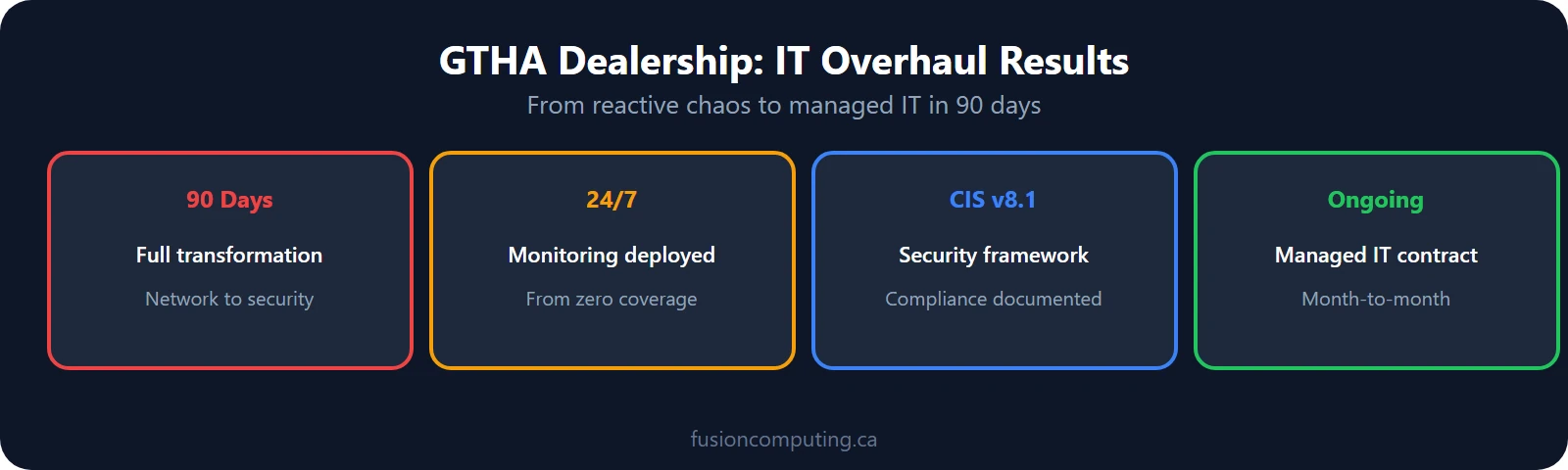
According to Fusion Computing’s client data, businesses that transition from reactive IT management to a structured managed IT agreement reduce their critical incident rate by more than 70% within the first 90 days.
A strategic IT overhaul is a planned transformation from reactive, ad-hoc IT management to a structured managed IT agreement covering network redesign, cybersecurity implementation, and ongoing operational support. According to Fusion Computing’s client data, businesses that make this transition reduce critical incidents by more than 70% within 90 days.
Introduction
Many industries are becoming more aware of the need to adopt smart technology solutions. From hospitality to automotive services, a strong digital infrastructure keeps becoming more important as threats and challenges grow more sophisticated. If you want better customer experiences and business growth, it’s the strength of a company’s IT support that drives those outcomes. It’s not about making the stack fancier. It’s about removing friction so the business can keep moving.
Fusion Computing has supported Canadian businesses since 2012, delivering managed IT and cybersecurity services with a 93% first-contact resolution rate. The company’s CISSP-certified security leadership and CIS Controls v8.1 alignment serve organizations with 10 to 150 employees across Toronto, Hamilton, and Vancouver.
In this case study, we’ll follow the journey of a local dealership that was facing significant IT and operational challenges. To breathe new life into the core digital operations of the business, Fusion Computing tailored a complete technology overhaul. What started with stabilizing day-to-day operations led to a solid foundation that encouraged scalability, increased business value, and future growth. It’s the kind of work that makes the next step easier, not noisier.

Client Overview
Struggling with fragmented systems, unmanaged devices, and outdated technology, a multi-location car dealership in the Greater Toronto and Hamilton Area (GTHA) — seeking reliable managed IT services Toronto — felt uncertain in its current digital infrastructure. This uncertainty fed into an environment of operational instability that eventually disrupted sales processes and impacted customer satisfaction. Without the assurance of perimeter security, the dealership witnessed a noticeable decline across various aspects of its business.
The Challenge
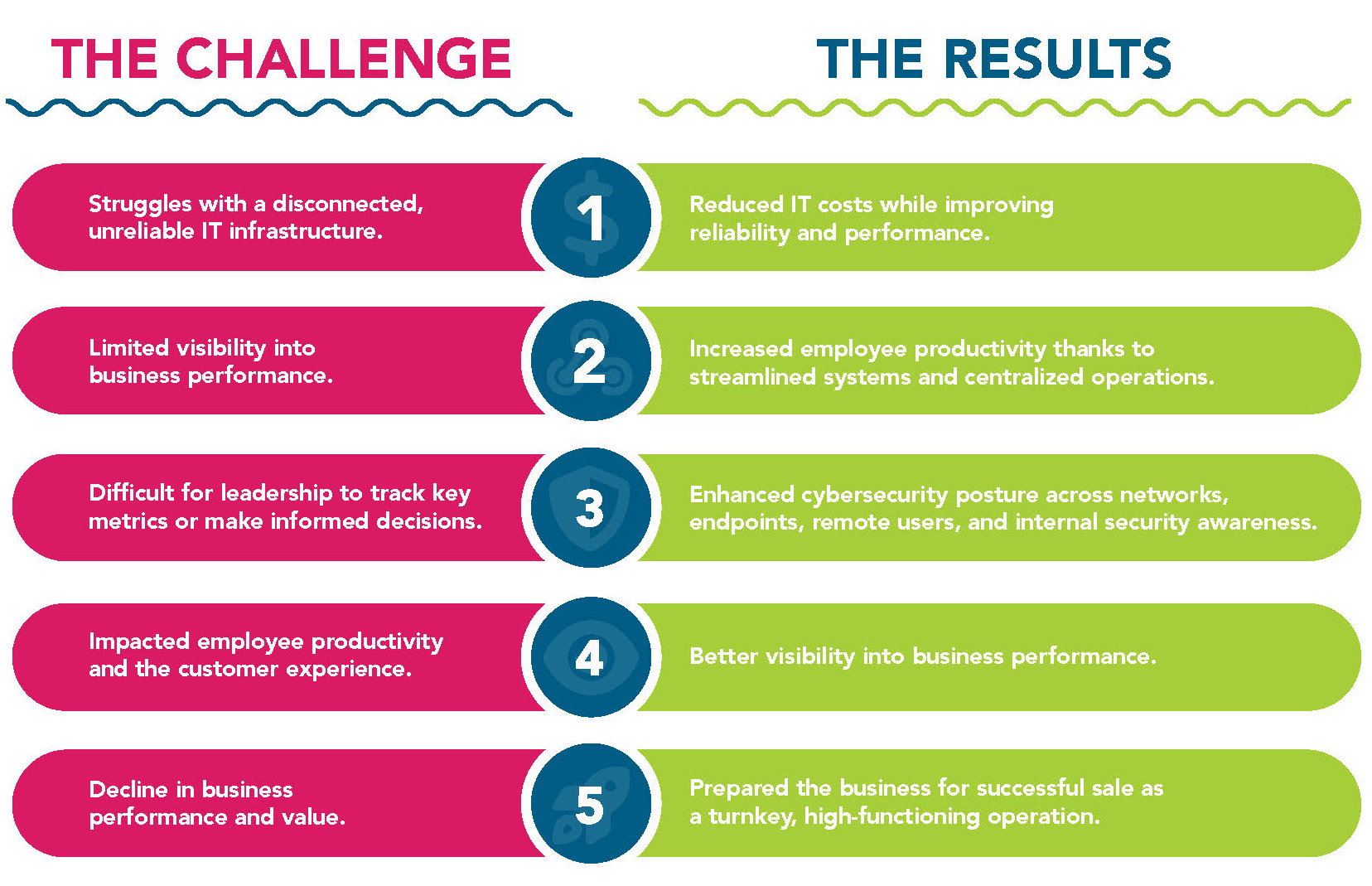
Our client struggled with a disconnected, unreliable IT infrastructure. Even the greatest businesses are only as strong as their weakest link, and the absence of endpoint security leaves systems vulnerable to cyber threats. At the same time, excessive spending on ineffective tech solutions started to take a toll. These factors quickly snowballed into a structural inadequacy unsuitable for optimized day-to-day operations.
The lack of cohesion in their technology stack translated to limited visibility into business performance, making it increasingly difficult for leadership to track key metrics or make informed decisions. System unreliability further impacted employee productivity and the customer experience, contributing to a decline in business performance and value.
Fusion Computing’s Approach
Fusion Computing delivered a phased IT transformation, focused on operational efficiency, security, and long-term scalability. But what does that look like? How does a car dealership benefit from partnered IT services in such a practical way? We’ve seen the pattern before, and it works because it starts with the basics.
1. Standardized IT Infrastructure
The transformation began by crafting a stable and consistent IT foundation across all dealership locations. The initial stages focused on deploying standardized workstations to replace outdated, inconsistent hardware, improving performance and simplifying support. Managed endpoint security and automated patching were introduced to enhance protection and reduce manual maintenance. Consistent Wi-Fi and LAN configurations were implemented to tie everything together, ensuring reliable connectivity and smoother day-to-day operations. These changes laid the groundwork for a more efficient and scalable IT environment.
2. Enhanced Security Posture
To address critical security gaps, a multi-layered security strategy was tailored to the dealership’s needs. Edge firewalls with SD-WAN capabilities were the best fit. These measures provide strong protection and improve network performance across all locations. Secure, point-to-point encrypted connectivity was also established between sites, ensuring safe and reliable data transfer. To further strengthen defences, staff received cybersecurity awareness training, helping reduce human risk factors and promoting a culture of security throughout the organization.
3. Streamlined Sales Operations via Centralization
The next step was to simplify sales operations by centralizing the dealership’s key systems. Fusion achieved this by hosting essential applications on unified platforms, significantly improving system performance and availability. This centralization reduced reliance on disparate systems, allowing quicker access to critical tools and data. As a result, IT overhead and support costs were slashed, enabling staff to focus more on sales and customer service instead of tending to technical headaches.
4. Creative Cost Optimization
Fusion focused on optimizing costs by replacing outdated legacy systems with more efficient, fit-for-purpose tools tailored to the dealership’s unique requirements. Vendor and licensing consolidation helped simplify operations and reduce unnecessary expenses. Additionally, SD-WAN and private network links were implemented to replace costly leased circuits, establishing a more affordable and scalable network solution without compromising performance or security.
5. Business Enablement and Value Creation
To enhance showroom efficiency, Fusion introduced integrated scheduling systems and wallboard displays, supporting efficient daily operations and improving staff coordination. These changes optimized internal workflows and enriched client interactions and the overall sales experience.
This solution ultimately provided valuable operational insights to the ownership and finance teams, enabling data-driven decision-making and greater visibility into business performance.
Results
- Reduced IT costs while improving reliability and performance
- Increased employee productivity thanks to streamlined systems and centralized operations
- Enhanced cybersecurity posture across networks, endpoints, remote users, and internal security awareness
- Better visibility into business performance
- Prepared the business for successful sale as a turnkey, high-functioning operation
Conclusion
Fusion Computing’s end-to-end IT modernization helped the client evolve from an underperforming dealership into a secure, efficient, and sale-ready business. By aligning technology with core business objectives, we delivered lasting value, better performance, and operational peace of mind.
Need the same kind of turnaround?
Contact Fusion Computing if you’re dealing with fragmentation, security gaps, or aging systems. You don’t need a giant rip-and-replace project. You need the right sequence.
Related Resources
- All Case Studies
- IT Business Assessment
- Cybersecurity Services
- Managed IT Support
- AI Services
- vCIO & vCISO
Fusion Computing serves Canadian businesses across:
Managed IT — Hamilton · Managed IT — Metro Vancouver · Managed IT – Cambridge · Managed IT – Cobourg · Managed IT – Etobicoke
Want Results Like These for Your Business?
Every engagement starts with understanding your environment. Book a 30-minute IT assessment.
The dealership struggled with fragmented systems, unmanaged devices, and outdated hardware across multiple locations. There was no endpoint security, limited visibility into business performance, and frequent system unreliability that disrupted sales processes and hurt customer satisfaction. Leadership couldn’t track key metrics or make informed decisions.
How did Fusion approach the dealership’s IT transformation?
Fusion took a phased approach, starting by stabilizing the foundation. They deployed standardized workstations, rolled out managed endpoint security and automated patching, and implemented consistent Wi-Fi and LAN configurations across all locations. This gave the dealership a reliable, uniform IT environment it could build on.
Why is endpoint security so important for car dealerships?
Dealerships handle sensitive customer financial data, vehicle financing records, and employee information. Without endpoint security, every workstation and mobile device is a potential entry point for attackers. Managed endpoint protection ensures threats are detected and contained before they can spread through the network or expose customer data.
How did the IT overhaul improve business performance and visibility?
Standardized systems gave leadership access to reliable data they could actually use. With consistent configurations and centralized IT management, tracking key metrics became possible. Reduced downtime meant staff could serve customers without interruption, and improved system reliability had a direct positive impact on sales and overall business value.
What does scalable IT infrastructure mean for a multi-location dealership?
Scalable IT means adding a new location or expanding operations doesn’t require starting from scratch. The standardized templates Fusion established can be replicated quickly, so the dealership can open new sites with the same security posture and performance from day one without delays or hidden costs.
How can managed IT services help dealerships reduce technology spending?
Unmanaged IT spending tends to balloon through reactive fixes, incompatible purchases, and vendor sprawl. A managed IT partner consolidates vendors, standardizes hardware lifecycles, and prevents costly downtime. For this dealership, the shift from fragmented ad hoc IT to a structured managed model reduced wasted spending and brought predictability.
Related Resources
Ready to talk IT for your business?
Fusion Computing has supported Canadian SMBs since 2012 — 93% first-contact resolution, CISSP-led team, fixed-price contracts. Get a free 30-minute assessment, no commitment.