
Quick Answer: Cyber vandalism is the deliberate alteration, defacement or disruption of digital property, most commonly websites, social media accounts or public-facing IT systems, for ideological, reputational or activist motives rather than financial gain. Unlike ransomware or data theft, the attacker’s goal is visibility and disruption, not profit.
According to the Verizon 2024 Data Breach Investigations Report, web application attacks (which include defacement) accounted for 25% of breach incidents analysed globally. Source: Verizon DBIR 2024.
Key takeaways:
- Cyber vandalism is motivated by ideology or reputation damage, not money. Standard anti-fraud defences don’t apply.
- Common targets: public websites, social channels, login portals plus visible brand assets. Critical infrastructure is increasingly a target.
- Top prevention steps: enforce MFA on CMS/admin logins, patch web applications within 14 days, WAF in front of public sites, and real-time defacement monitoring.
- If hit: preserve logs, take a forensic snapshot before restoring, notify affected users, then review access controls.
The Canadian Centre for Cyber Security’s National Cyber Threat Assessment 2025-2026 names disruptive attacks, including website defacement and wiper malware, as a persistent and growing threat to Canadian organizations. For any business with a public-facing website or social presence, the real question is not whether you will be targeted but how quickly you can detect the change and recover.
Fusion Computing has remediated website defacements, hijacked social accounts and insider data-destruction incidents for Canadian businesses since 2012. Fusion Computing’s security practice is CISSP-led, works from a Dundas office, serves Toronto, Hamilton and Metro Vancouver, and answers priority incidents within 1 hour.
One type of cybercrime that small and medium businesses consistently underestimate is called cyber vandalism.
But what is cyber vandalism? How does it differ from ransomware or data theft? And how do you protect a Canadian business that lives on its website and social accounts?
This guide covers the cyber vandalism definition, the 4 main attack types, who carries them out, and the 6 controls that stop most incidents.
KEY TAKEAWAYS
- Cyber vandalism is deliberate digital destruction without financial motive: defacement, disruption or data destruction.
- It’s a criminal offence under Canada’s Criminal Code (Section 430). Strong access controls and monitoring prevent most incidents.
Mike Pearlstein is CEO of Fusion Computing and holds the CISSP, the gold standard in cybersecurity certification. He has led Fusion’s managed IT and cybersecurity practice since 2012, serving Canadian businesses across Toronto, Hamilton and Metro Vancouver.
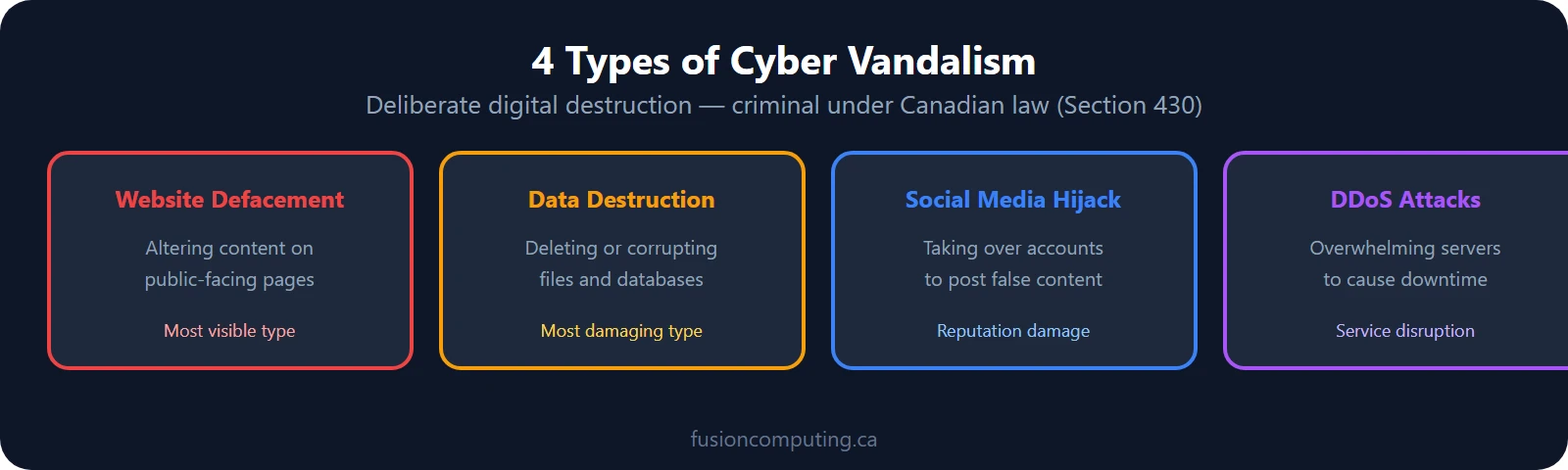
Cyber vandalism is the deliberate defacement, disruption or destruction of digital assets such as websites, databases, social media accounts or online systems, without financial motive. Under Canada’s Criminal Code (Section 430), mischief in relation to computer data is a criminal offence carrying fines and imprisonment.
Cyber vandalism definition: what it is, examples, and business impact
Under Section 430(1.1) of Canada’s Criminal Code, mischief in relation to computer data is a criminal offence carrying up to 10 years in prison. The provision covers destroying or altering data as well as obstructing anyone’s lawful use of it, which describes nearly every cyber vandalism scenario a Canadian business will face.
Cyber vandalism is the deliberate defacement, disruption or destruction of digital assets (websites, databases or systems) without financial motivation. The attacker’s goal is damage, embarrassment or disruption, not profit. That distinction matters because the anti-fraud controls most Canadian firms deploy first do not fully address it.
Three common examples show the pattern clearly:
- Website defacement. An attacker replaces a company’s homepage with their own message or imagery. The site still functions, but the brand is publicly embarrassed until the content is restored.
- DNS hijacking. An attacker redirects a domain to a different server. Visitors land on a fraudulent page while the legitimate site stays intact, making the attack hard to detect quickly.
- Database wipe. An attacker with inside access or stolen credentials deletes records outright. There is no ransom demand. The data is simply gone unless a backup exists.
Business impact spans three categories. Reputational damage is immediate: customers who see a defaced site or receive confirmation of a data wipe lose confidence fast. Operational downtime follows while IT teams restore systems, often measured in hours or days. Recovery cost includes forensic investigation, staff time and potential regulatory notification under PIPEDA if personal data was involved.
Because the motive is disruption rather than payment, prevention focuses on access controls, monitoring for unauthorized changes, and verified backups. Perimeter defences built for financial attackers are not enough on their own; the CCCS baseline exists for exactly this gap.
When the target is a personal email or social account rather than a company site, the recovery sequence differs on 3 of the 6 steps. Follow our guide to cybersecurity help for individuals who’ve been hacked.
What is Cybervandalism: Intended Effects & Perpetrators
According to the Canadian Centre for Cyber Security (2025), ransomware remains the top cybercrime threat to Canadian critical infrastructure, with state-sponsored and AI-assisted attacks increasing both the pace and the sophistication of intrusions. Fusion Computing maps these threats to controls under CIS Controls v8.1 and the NIST Cybersecurity Framework.

Cyber vandalism is the deliberate defacement or destruction of digital assets without financial motive. The 4 common forms are website defacement (replacing content with messages or images), distributed denial-of-service (DDoS) attacks that take services offline, deletion or corruption of databases, plus hijacked social media accounts. The motive is ideology, revenge or notoriety rather than financial gain.
TL;DR
Cyber vandalism is the deliberate defacement, disruption or destruction of digital assets such as websites, databases and social media accounts, with no financial motive. It’s driven by ideology, revenge or boredom rather than profit. The 4 common forms: website defacement, DDoS attacks, data deletion and social media hijacking. Any internet-facing business is a potential target, and prevention starts with basic access controls and monitoring.
To best describe the cyber vandalism definition (data vandalism definition, if you prefer that term) it’s a type of cyber crime where the sole purpose is to cause damage or disruption. Monetary gain plays no part, and Canadian courts prosecute it as mischief under Section 430.
The effects can be significant and long-lasting. A hospital knocked offline by a denial-of-service attack may postpone procedures and divert patients, and a Canadian retailer defaced during a peak sales week loses revenue for every hour the page stays vandalized.
In other cases, like when website defacements occur, the effect is more psychological than anything else. The business whose website has been vandalized will suffer from reputational damage, which can lead to lost customers and revenue. Fast Company’s 2022 hack is the textbook example.
Who carries out these attacks? In most of the cases Fusion Computing triages, it’s individuals or groups holding a grudge against the business or organization they’re targeting.
They could be disgruntled employees, former customers with a vendetta, or strangers who simply want to watch something break.
Whatever the motivation, the CCCS assessment is blunt: disruptive attacks are a persistent threat, and businesses need a plan before one lands. So what do these attacks look like in practice? The 4 patterns below cover most incidents.
Types of Cyber Vandalism Attacks: An Overview
According to the Canadian Centre for Cyber Security, its Baseline Cyber Security Controls for small and medium organizations are a starting set spanning multi-factor authentication, patching, backups and incident response. The set aligns with CIS Controls v8.1. Treat that baseline as the minimum, not the ceiling. It gives a Canadian SMB a defensible reference point, and it maps onto the safeguards an insurer or regulator expects to see documented.

Cyber vandalism is the deliberate defacement, disruption or destruction of digital assets such as websites, databases, social media accounts or online services. Unlike financially motivated cybercrime, cyber vandalism is often driven by ideology, revenge, or notoriety. Businesses can prevent most incidents with 3 controls: strong access controls, web application firewalls and tested backups.
There are many different types of cyber vandalism attacks, each with its own unique goals and methods. Here are the 5 most common:
Website Defacement
Attackers gain access to a website and replace its content with something offensive or politically charged. Most defacements exploit 1 of 2 weaknesses: a CMS admin login without MFA, or a plugin with a known, unpatched CVE.
DDoS Attacks
A distributed denial-of-service (DDoS) attack floods a server with requests until it stops responding. The scale is industrial: Cloudflare (2025) blocked 20.5 million DDoS attacks in the first quarter of 2025 alone, a 358% jump year over year. Even a basic CDN tier absorbs most low-effort attempts.
Malware Attacks
Malware injected into a system can corrupt databases, break booking and e-commerce functions, or quietly turn your site into a spam relay. In vandalism cases the payload is chosen for disruption, which is why a 14-day patch window on public-facing software matters more than any single security product.
Wiper & Data Destruction Attacks
Wiper malware deletes or corrupts files outright, with no ransom note and no decryption key. The Canadian Centre for Cyber Security groups wipers with defacement as disruptive threats because the goal is damage. Ransomware wants payment; a wiper leaves you nothing to buy back, so tested backups are the only recovery path.
Social Media Attacks
Attackers take over a business’s social accounts and use them to spread misinformation or post offensive content. When Fast Company’s systems were hijacked in 2022, attackers pushed obscene alerts through its Apple News channel and the publication stayed dark for roughly a week while it rebuilt.
The damage from any of the 5 can be significant, so the next question is practical: what do you do about them?
Where Do Cyber Vandalism Attacks Actually Start?
Vandalism and defacement incidents start in one of four places. They are an admin credential with no MFA, an unpatched CMS or plugin, insider access, and a hijacked social or DNS account. The first two are the cheapest for a business to close.
Spend first on those two. MFA on every admin surface plus a 14-day patch cycle closes the doors attackers try first. Neither control needs new hardware, and both sit inside the CCCS baseline you may already claim to follow on an insurance form.
Protection Strategies for Cyber Vandalism Attacks
According to Microsoft security research, enabling multi-factor authentication blocks more than 99.9% of automated account-compromise attacks. Fusion Computing treats admin-surface MFA as the highest-return control against defacement and account hijacking because, in its own incident data, roughly half of vandalism events started with a credential nobody protected.

The 6 defences in the chart above are where Canadian businesses should start when hardening against electronic vandalism attacks. The most important include:
Keep Software & Systems Up to Date
Unpatched, internet-facing software is one of the most common entry points for defacement. Set a 14-day window for critical patches on your CMS, its plugins and the hosting stack, and inventory the plugins nobody remembers installing.
Educate Employees
Train staff to recognize credential phishing, the precursor to most account hijacks. The Canadian Anti-Fraud Centre logs hundreds of millions of dollars in reported fraud losses each year, and the same stolen passwords that feed fraud also feed defacement and account takeover.
| Learn More About How Cyber Security Can Protect Your Business from Online Threats with These Other Short Articles: |
Use Strong Passwords
Every password should be 14 or more characters, unique to 1 account, and stored in a password manager. Reuse is how a credential stolen in an unrelated 2023 breach becomes your defaced homepage in 2026.
Enable Two-Factor Authentication
Require a second factor on every admin surface: CMS, hosting panel, DNS registrar, plus your social accounts. Per the Microsoft figure above, this single control stops more than 99.9% of automated account attacks. Social accounts are the surface Canadian SMBs forget most often.
Backup Data Regularly
Follow the 3-2-1 rule: 3 copies of your data, on 2 different media, with 1 kept offsite or immutable. A backup you have never test-restored is a hope. A tested restore is what turns a data-destruction incident from a 3-day outage into a 4-hour one.
These controls overlap heavily with general cybersecurity hygiene, which is the point: the same 6 defences that frustrate a ransomware crew also frustrate a vandal. It’s the same playbook Fusion Computing’s CISSP-led team runs for its own managed clients.
“Our homepage was replaced on a Friday night. Fusion had eyes on it within the hour, a clean copy back up the same evening, and by Monday we had MFA on every admin account we owned. The scariest part was learning how many logins we’d never secured.”

How Do You Recover From a Cyber Vandalism Attack?
According to the Office of the Privacy Commissioner of Canada, any breach that creates a real risk of significant harm must be reported to the OPC and to affected individuals. Records of every breach must be kept for 24 months. A defacement that exposes personal information is a privacy incident as well as vandalism.
The first 24 hours decide most of the cost. Work the sequence in order:
- Contain. Take the affected system offline or into maintenance mode, and revoke every session and API token tied to it.
- Snapshot before you touch anything. Preserve logs and take a forensic image or hosting-level snapshot. Evidence disappears the moment you rebuild.
- Identify the entry point. Check admin logins, plugin versions, recent file changes. Restoring without closing the door invites round 2.
- Restore from a known-clean backup. Verify content integrity before going live again.
- Rotate every credential. CMS, hosting, DNS, database, social, plus fresh MFA enrollment for each.
- Assess notification duties. If personal information was exposed, run the PIPEDA real-risk test and document the decision either way.
Recovery time turns on the backup. With a tested backup and a staffed response, a defaced site can usually be restored the same day. Without a tested backup, restoration stretches into days, and the forensic work can cost more than the rebuild.
Enlisting the Help of a Managed Service Provider to Protect Against Cyber Vandalism
According to Statistics Canada, its survey of cyber security and cybercrime finds that small and medium businesses absorb a disproportionate share of incident impact while running the leanest security teams. Fusion Computing maps the resulting fundamentals, multi-factor authentication, patching and tested backups, to CIS Controls v8.1.
Cyber vandalism is a problem Canadian businesses need to plan for before they have to react to it. Statistics Canada pegs total recovery spending at CA$1.2 billion in 2023, double the 2021 figure, and SMBs carry that cost with the smallest teams.
The attack surface is wide, but the response does not have to be complicated. One of the most reliable ways to stay ahead is a qualified managed IT provider. Fusion Computing has run that playbook for Canadian businesses since 2012, with advanced security services including:
- Network Monitoring & Maintenance
- Data Breach Resolution
- Cyber Security Consulting
- Disaster Recovery Planning & Implementation
- Firewall Management
- Antivirus Implementation, Patching and Upgrades
Managed cybersecurity for Canadian SMBs typically runs CA$185 to CA$230+ per user per month, and full managed IT engagements start at CA$185 per user per month. If you’d like the controls in this guide verified against your own site and social accounts, book a consultation.
Related Resources
Fusion Computing serves Canadian businesses across:
Fusion Computing is a CISSP-led managed security services provider (MSSP) serving Canadian businesses since 2012. All security operations align to CIS Controls v8.1, with 24/7 managed detection and response, endpoint protection and incident response. Delivered from Canadian offices with all data stored in Canada.
Cybersecurity Services Toronto · Cybersecurity Services Hamilton · Cybersecurity Services Vancouver
Free download
The Network Security Controls Checklist (2026)
The six defences above, plus perimeter, identity, endpoint and backup controls, rewritten as yes/no items you can audit against your own site. Includes MFA on the admin consoles. For use alongside the Canadian Centre for Cyber Security baseline controls.
No sales call required. Want these controls verified against your own site and social accounts? Book a consultation.
What Does Your Business Need to Do Next?
Start with the 3 controls that close the most incidents: MFA on every admin login, a 14-day patch window, and a tested restore. Add change monitoring so a defacement becomes a 5-minute alert instead of a customer phone call. Fusion Computing’s CISSP-led team answers priority incidents within 1 hour.
Frequently asked questions
This article is part of Fusion Computing’s cybersecurity services hub, which covers the full Canadian SMB security program from CISSP-led strategy through 24/7 managed detection and response, incident handling and awareness training.
For deeper coverage of the credential theft and disruption tactics behind most cyber vandalism, read our explainer on managed detection and response (MDR). Then see our breakdown of how a Canadian MSSP works alongside your IT team, and our analysis of AI-powered cyber threats facing Canadian SMBs in 2026.
Why this matters in Canada: The Canadian Centre for Cyber Security’s National Cyber Threat Assessment flags hacktivism, website defacement and disruptive wiper malware as persistent threats to Canadian organizations, particularly those with public-facing brands or politically sensitive operations.
Statistics Canada’s Canadian Survey of Cyber Security and Cybercrime reports that roughly one in six Canadian businesses experienced a cybersecurity incident in a single year. Unauthorized website modification and account takeover were among the most commonly reported categories. The Canadian Anti-Fraud Centre logs hundreds of millions of dollars in annual phishing and credential-theft losses, the same stolen credentials that enable most defacement and hijack incidents.
Under PIPEDA and the Office of the Privacy Commissioner of Canada’s breach reporting guidance, any vandalism event that exposes personal information triggers mandatory assessment and, where warranted, notification. Sources: cyber.gc.ca, statcan.gc.ca, antifraudcentre-centreantifraude.ca, canada.ca, ised-isde.canada.ca.
What is cyber vandalism?
Cyber vandalism is the deliberate defacement, disruption or destruction of digital assets such as websites, databases, social media accounts or online systems, without financial motive. Unlike ransomware, the goal is damage or embarrassment rather than payment, and under Canadian law it’s criminal mischief.
How do you prevent cyber vandalism?
Prevention starts with 4 controls: MFA on every admin login, regular patching, change monitoring and a web application firewall (WAF) for public-facing sites. Employee security awareness training reduces the risk of credential compromise that enables vandalism.
Is cyber vandalism a crime in Canada?
Yes. Under Canada’s Criminal Code (Section 430), mischief in relation to computer data is a criminal offence. This includes destroying, altering or interfering with the lawful use of computer data. Penalties can include fines and imprisonment.
What’s the difference between cyber vandalism and hacking?
Hacking is unauthorized access to systems, which may or may not cause damage. Cyber vandalism specifically involves destructive or defacing acts. It’s a subset of hacking focused on causing visible harm rather than stealing data, and the 2 usually share the same entry points.
What’s the difference between cyber vandalism and ransomware?
Motive. Ransomware encrypts your data to extort payment, and the attacker wants you back online to pay. Cyber vandalism destroys or defaces with no payment path, so recovery depends entirely on your own backups and monitoring. The 2 threats share the same 3 entry points: stolen credentials, unpatched software and phishing.
How much does it cost to protect a small business against cyber vandalism?
Core controls are inexpensive: MFA is often free, and change monitoring for a small site starts around CA$20 per month. Fully managed cybersecurity for Canadian SMBs typically runs CA$185 to CA$230+ per user per month, and managed IT engagements start at CA$185 per user per month.
How quickly can a defaced website be restored?
With a tested backup and a staffed response, a defaced site can usually be restored the same day. Without a tested backup, expect several days, plus forensic costs that can exceed the rebuild itself.
Do I have to report a cyber vandalism incident under PIPEDA?
If the incident creates a real risk of significant harm to any individual, yes. PIPEDA requires a report to the Privacy Commissioner of Canada and notification of affected people as soon as feasible. You must also keep records of every breach, reportable or not, for 24 months.
Does cyber insurance cover cyber vandalism?
Most Canadian cyber policies cover website restoration, data recovery and business interruption caused by vandalism, but insurers increasingly require MFA, tested backups and patching evidence before paying a claim. Read the exclusions: some policies carve out hacktivism and state-sponsored attacks, the 2 motives behind many defacements.
Is my small business really a target for cyber vandalism?
Yes. Statistics Canada found about 1 in 6 Canadian businesses experienced a cybersecurity incident in 2023. Most vandalism is opportunistic: automated scanners hunt for an unpatched plugin or an admin login without MFA, and the attacker takes whatever site answers.
Who commits cyber vandalism?
4 groups: hacktivists making a political statement, low-skill attackers chasing notoriety with automated tools, insiders such as disgruntled employees or contractors, and state-sponsored actors. For Canadian SMBs, opportunistic attackers and insiders account for most real incidents.
How do I protect our social media accounts from hijacking?
Turn on MFA for every account and admin, remove departed employees the same day, limit admin rights to 2 or 3 people, and use a scheduling platform so staff never handle the native password. Treat login-alert emails seriously: they’re often the first sign of a takeover.
Last reviewed: July 2026. Fusion Computing