
Google Workspace vs Microsoft 365: Market Share, Cost, and Which Wins for Canadian Businesses (2026)
Written by Mike Pearlstein, CISSP — CEO of Fusion Computing Limited. Helping Canadian businesses build and manage secure IT infrastructure since 2012 across Toronto, Hamilton, and Metro Vancouver.
Google Workspace vs Microsoft 365 is a decision that depends almost entirely on your business size, industry, and compliance requirements — not the headline market share numbers. Google Workspace dominates micro and small businesses; Microsoft 365 dominates enterprise and regulated industries. But for Canadian SMBs with 10 to 150 employees, the answer lives in the details: data residency, security stack depth, AI costs, and migration complexity. Google Workspace holds 50.3% of the market by total domains, driven by micro and small businesses under 10 employees. Microsoft 365 dominates the enterprise segment at 58% and is the primary platform for 75% of Fortune 500 companies.
Those numbers tell you something important: neither platform “wins” universally. Google wins on simplicity and real-time collaboration for small teams. Microsoft wins on security depth, compliance tooling, and desktop app maturity for regulated businesses. The real question is which set of trade-offs your business can live with.
This guide breaks down the 2026 comparison with actual Canadian pricing, market share data, security feature differences, and an honest look at where each platform falls short. We manage both platforms across our client base – this isn’t a vendor pitch.
Key Takeaways
- Google Workspace owns 50.3% of domains globally; Microsoft 365 owns 58% of the enterprise market and 75% of the Fortune 500 (6sense, 2026).
- Microsoft 365 Business Premium (CA$29.80/user/month) bundles Defender, Intune, and Conditional Access. Google Workspace requires third-party add-ons for equivalent security.
- Google Gemini AI is included free with Business Standard. Microsoft Copilot is a CA$24.43/user/month add-on – but its cross-app orchestration across Word, Excel, Outlook, and Teams is deeper.
- For Canadian businesses needing data residency, Microsoft 365 stores data in Canadian Azure regions (Toronto, Québec City). Google Workspace’s data region options are US, EU, or “No preference” – Canada isn’t available.
What does the market share data actually tell us?
Microsoft 365 holds 58% enterprise market share versus Google Workspace’s 38%, driven by M365’s depth in hybrid work, compliance tooling, and Windows ecosystem integration. For Canadian SMBs, the decision typically comes down to existing infrastructure: organizations already running Windows Server, Azure AD, or Microsoft security products have strong reasons to standardize on M365.
Google Workspace vs Microsoft 365: Microsoft 365 provides desktop apps (Word, Excel, PowerPoint), enterprise security (Defender, Intune, Conditional Access), and compliance tools (DLP, eDiscovery). Google Workspace offers browser-based collaboration (Docs, Sheets, Slides), simpler admin, and competitive pricing for small teams. Microsoft 365 is preferred by security-conscious organizations; Google Workspace suits teams prioritizing simplicity and real-time collaboration.
TL;DR
Microsoft 365 offers deeper enterprise security (Defender, Intune, Conditional Access) and desktop app parity. Google Workspace wins on simplicity, real-time collaboration, and lower entry pricing. From an MSSP’s perspective, Microsoft 365 integrates more tightly with managed security monitoring and MDR tooling. For most Canadian SMBs that need compliance and managed security, Microsoft 365 is the stronger foundation—but the right choice depends on your team’s workflow.
The market share numbers get cited constantly, but they’re misleading without context. Google Workspace’s 50.3% share counts every domain – including solo freelancers, family businesses, and one-person shops. Microsoft 365’s 45.5% by domains undercounts its real footprint because enterprise deployments cover thousands of users per domain.
Here’s what the data looks like when you segment by company size:
| Segment | Google Workspace | Microsoft 365 |
|---|---|---|
| 1–9 employees | Dominant (1M+ domains) | Secondary |
| 10–200 employees | Strong, especially cloud-native | Strong, especially regulated industries |
| 200+ / Enterprise | 42% of Fortune 500 (often dual-stack) | 75% of Fortune 500 (primary platform) |
| Platform switches (2025) | 42% switched TO Google | 58% switched TO Microsoft |
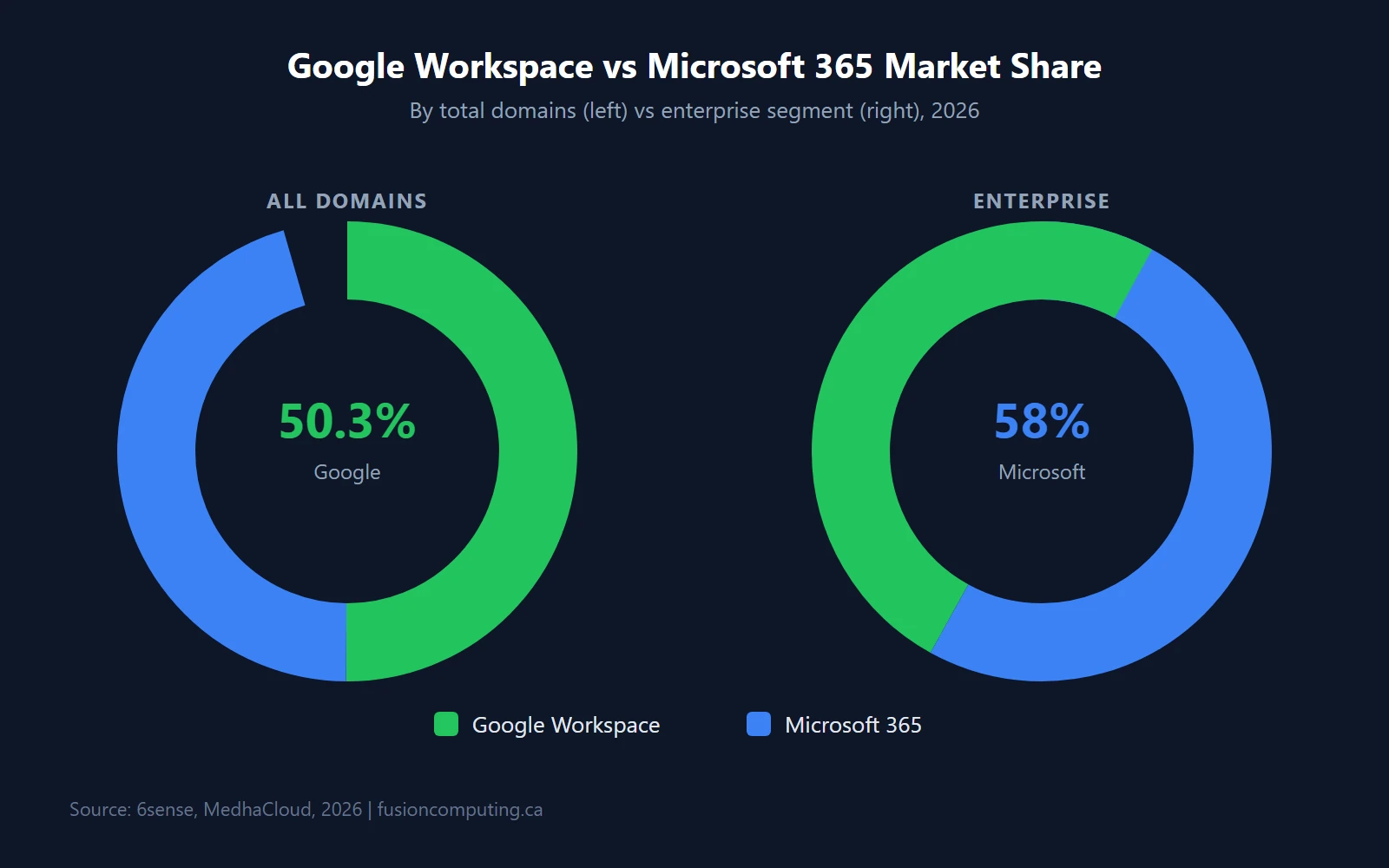
According to MedhaCloud’s 2026 analysis, Microsoft 365 commercial revenue exceeds $60 billion annually and grew 16% year-over-year, while seat count grew 12%. The migration trend also favours Microsoft: 58% of organizations that switched platforms in 2025 moved from Google Workspace to M365, versus 42% going the other direction. That doesn’t mean Google is losing – it’s still growing in absolute numbers – but the net flow tells you where mid-market businesses are landing after they’ve tried both.
According to Statista’s 2025 data, Microsoft Office products still hold the largest share of the global office productivity market when measured by revenue rather than domains. That’s partly because enterprise contracts are worth more per seat, and partly because M365’s bundled security and compliance tools command higher pricing.
In Canada specifically, Microsoft 365 adoption is higher among regulated industries – finance, healthcare, and legal – due to deeper compliance tooling and Canadian data centre availability.
How much do Google Workspace and Microsoft 365 cost in Canada?
Microsoft 365 is the stronger choice for most businesses because of its deeper integration with enterprise tools like Teams, SharePoint, Power Automate, and Copilot AI. Google Workspace suits organizations that prioritize simplicity and real-time collaboration. Businesses with compliance requirements or complex workflows typically benefit more from Microsoft 365’s ecosystem.
All prices below are in Canadian dollars per user per month on an annual commitment, sourced from official vendor pricing pages as of April 2026. GST/HST is extra.
| Tier | Microsoft 365 | Google Workspace |
|---|---|---|
| Entry | Business Basic – CA$8.10/user/mo | Business Starter – CA$8.00/user/mo |
| Mid-tier | Business Standard – CA$17.00/user/mo | Business Standard – CA$16.00/user/mo (includes Gemini AI) |
| Full security | Business Premium – CA$29.80/user/mo | Business Plus – CA$28.70/user/mo |
| AI add-on | Copilot – CA$24.43/user/mo (add-on) | Gemini – included with Standard+ |
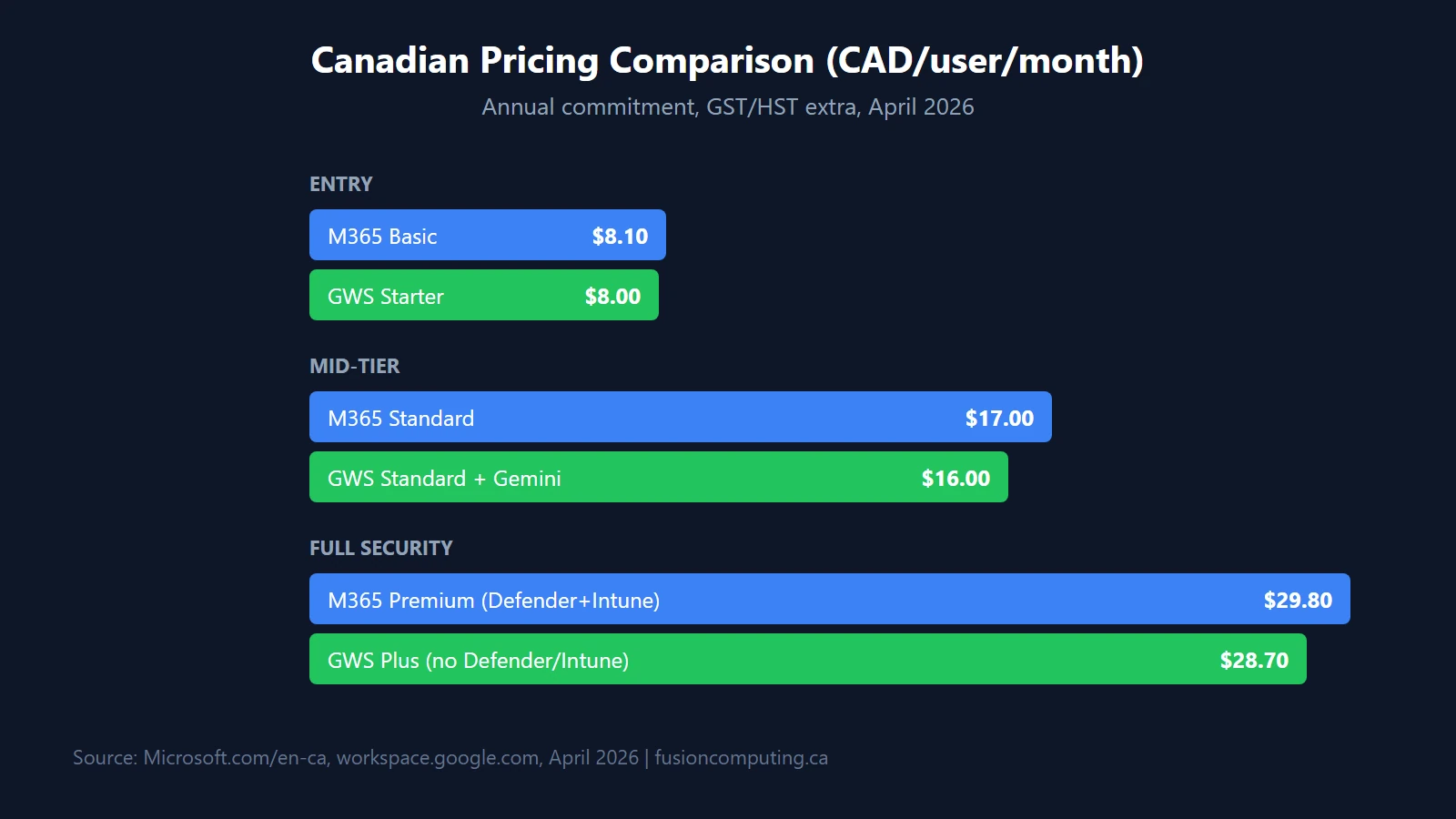
At face value, Google is slightly cheaper at every tier. But Microsoft 365 Business Premium bundles endpoint management (Intune), Defender for Business, and Entra ID Conditional Access – capabilities that Google Workspace requires third-party add-ons like CrowdStrike, Jamf, or Okta to replicate. When you add those tools to Google, the cost gap disappears or reverses.
For businesses with 20+ employees, the total cost of ownership usually favours Microsoft. For teams under 10 that don’t need Intune or Defender, Google Workspace Business Standard is a legitimate choice – and the bundled Gemini AI is a genuine cost advantage.
Which platform has better security?
Both platforms provide strong baseline security. The difference is in granularity and what’s included versus what’s an add-on.
Microsoft 365 Business Premium security stack
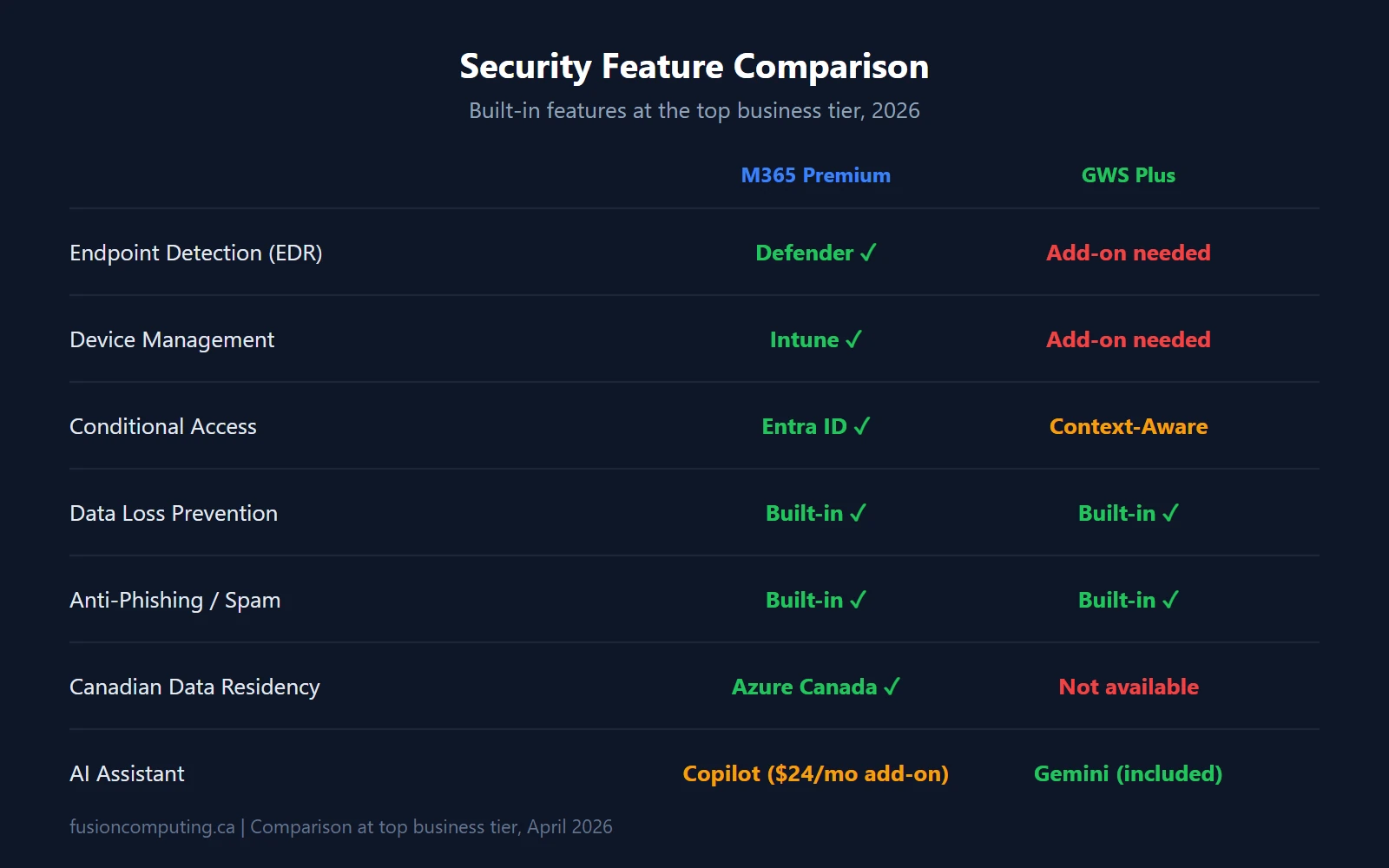
Microsoft 365 Business Premium includes enterprise-grade security out of the box: Defender for Business (endpoint detection and response), Entra ID Conditional Access (control who accesses what, from where, on which device), Intune (device compliance and management), Data Loss Prevention, and MFA enforcement. These aren’t add-ons – they’re built into the CA$29.80/user/month price.
At Fusion Computing, every M365 client’s environment is configured against CIS Controls v8.1 and reviewed by CISSP-certified leadership. That level of granular control is what makes M365 the default choice for regulated Canadian industries.
Google Workspace security
Google Workspace uses a secure-by-default model that blocks the vast majority of spam and phishing without complex configuration. The admin console is simpler than Microsoft’s – which is both a strength and a limitation. For businesses that want strong baseline protection without the overhead of managing Conditional Access policies, Google’s approach works.
The gap shows up when you need granular device compliance, data loss prevention across endpoints, or identity-based access controls for a hybrid environment. Those require third-party tools with Google – and those tools have their own licensing, configuration, and management overhead. It’s not that Google can’t get there. It’s that you’ll spend more time and money assembling what Microsoft includes out of the box.
According to Gartner Peer Insights, both platforms receive strong user ratings. Microsoft 365 scores higher on breadth of features and compliance; Google Workspace scores higher on ease of use and onboarding speed. The right choice depends on which dimension matters more to your business – and there’s no wrong answer if you’re honest about your priorities.
Copilot vs Gemini: which AI assistant wins for business?
Microsoft 365 Copilot integrates with Word, Excel, PowerPoint, Outlook, and Teams – cross-app orchestration is its key differentiator. Copilot can turn Excel data into a formatted PowerPoint deck, summarize meetings into action items, and draft email responses using context from across your M365 environment. It’s currently available at CA$24.43/user/month as an add-on (promotional pricing through June 2026; regular CA$28.50).
Google Gemini is bundled into Workspace Business Standard and above at no additional cost – and that’s a genuine advantage. It offers a larger context window (up to 1 million tokens in Gemini Advanced versus ~400,000 for Copilot) and integrates tightly with Google Search for real-time information.
Here’s the practical difference: Copilot is deeper within its ecosystem. Gemini is broader and cheaper. Fusion Computing’s recommendation for most SMBs is to start Copilot licensing for 5–10 power users and expand based on ROI, rather than licensing every seat on day one. That makes M365’s AI cost manageable while giving you cross-app capabilities Gemini can’t match. For more on how Fusion Computing deploys AI for Canadian businesses, see our AI deployment case study.
Does Microsoft 365 or Google Workspace support Canadian data residency?
This matters for PIPEDA compliance and for businesses whose clients or regulators expect data to stay in Canada.
Microsoft 365 stores core customer data at rest in Azure Canada regions (Toronto and Québec City). Combined with Purview compliance tooling, eDiscovery, and retention policies, this gives regulated Canadian businesses – legal, healthcare, financial services – a clear governance advantage.
Google Workspace Business Standard and Plus support data region selection, but the available choices are the United States, the European Union, or “No preference.” Canada isn’t an option. Enterprise editions add more granular controls but the same region limitation applies. PIPEDA doesn’t prohibit cross-border data transfers outright, but Canadian data residency is a meaningful risk-reduction measure – and it’s something Microsoft offers that Google currently doesn’t.
Canada’s Critical Cyber Systems Protection Act (Bill C-8) may also affect compliance obligations depending on your industry. If your cyber insurance policy requires Canadian data storage, Microsoft 365 is the easier path to compliance.
Get a Custom IT Assessment for Your Business
When does Google Workspace win?
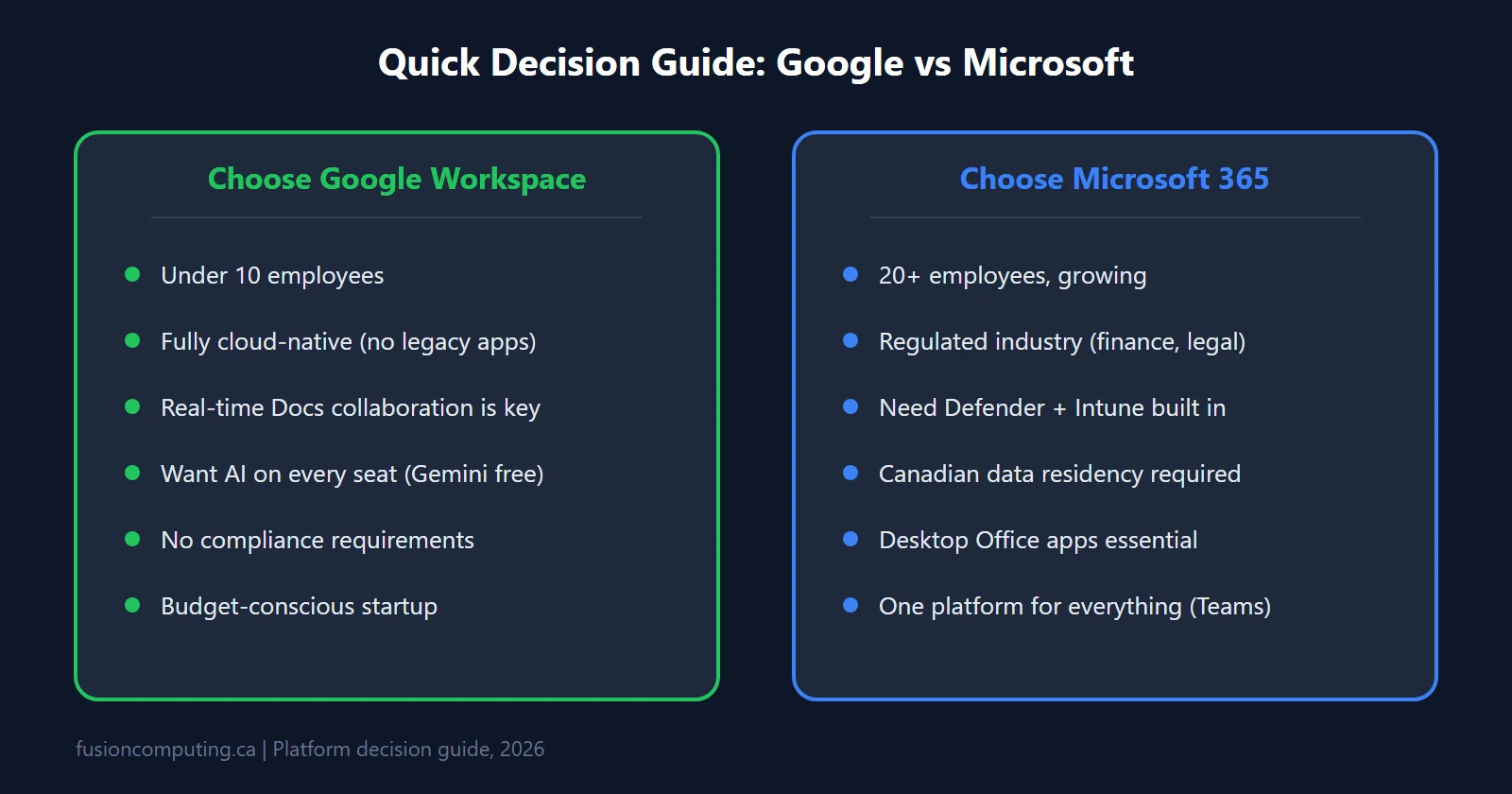
We’d be doing you a disservice if we only made the case for Microsoft. Google Workspace is the better choice when:
- Your team is under 10 people and fully cloud-native – no legacy Windows apps, no on-prem servers
- Real-time collaboration in Google Docs is your team’s primary workflow (it’s still faster than M365’s co-authoring)
- You want AI capabilities on every seat without per-user add-on fees – Gemini is included with Business Standard
- Your team already lives in Chrome and the Google ecosystem – switching costs outweigh any M365 advantage
- You don’t need Intune, Defender, or Conditional Access – and you’re honest about that assessment
Where Google falls short: as businesses grow past 20–30 employees and compliance requirements increase, most find they can’t avoid bolting on third-party security tools – at which point the simplicity advantage disappears and total cost often exceeds M365 Business Premium.
When does Microsoft 365 win?
Microsoft 365 is the stronger choice when:
- You have 20+ employees with growing security and compliance needs
- Your business is in a regulated industry – finance, healthcare, legal – where Conditional Access and DLP aren’t optional
- You need Canadian data residency for governance or insurance requirements
- Your team relies on desktop Office apps – Excel power users, Word document workflows, PowerPoint presentations
- You want one platform for email, chat, video, voice, file storage, device management, and security – Teams replaces Slack, Zoom, and Webex
- You work with an MSP – Microsoft 365 integrates deeply with the PSA, RMM, and identity tools that managed IT providers use
Fusion Computing recommends M365 Business Premium for most of our clients with 10–150 employees. Not because we’re a Microsoft shop – we manage both platforms – but because the bundled security stack eliminates the need to piece together third-party tools that create integration gaps and increase management complexity. If you’re working with an MSP, you’ll also find that M365’s integration with PSA and RMM tools makes monitoring, patching, and incident response significantly faster.
Which platform should your business choose? A quick self-check
Answer these five questions honestly. They’ll point you in the right direction faster than any feature matrix.
- Do you need device management or endpoint security? If yes → Microsoft 365 Business Premium (Intune + Defender included). Google requires third-party add-ons.
- Does your industry have compliance requirements (PIPEDA, PHIPA, PCI-DSS)? If yes → Microsoft 365. Its Purview compliance suite and Canadian data residency are hard to replicate with Google.
- Is your team under 10, fully cloud-native, and doesn’t need desktop Office apps? If yes → Google Workspace Business Standard. Simpler, cheaper, and Gemini is included.
- Do you want AI on every seat without managing per-user add-ons? If yes → Google Workspace (Gemini included). Copilot works best licensed selectively for power users.
- Are you already in one ecosystem? Switching costs are real. If your team lives in Google Drive, the ROI of migrating to M365 needs to be significant. Same in reverse.
If you checked Microsoft for 3 or more, M365 Business Premium is likely the right call. If you checked Google for 3 or more – or your team is small and cloud-native – Google Workspace will serve you well. Still unsure? That’s exactly what our IT assessment is for.
Fusion Computing helps businesses evaluate, migrate, and manage both platforms across Toronto and the GTA, Hamilton, and Metro Vancouver.
Related resources
- Microsoft 365 Copilot & AI Services
- Managed IT Services for Canadian Businesses
- Cybersecurity Services
- Co-Managed IT Services
- Cloud Migration Challenges
- SaaS vs Cloud Computing
- IT Budget Guide for Canadian Small Businesses
- Virtual CIO Services
Book a 30-Minute IT Assessment
Frequently asked questions
What is the market share of Google Workspace vs Microsoft 365 in 2026?
Google Workspace holds 50.3% of the global market by total domains, driven by micro and small businesses under 10 employees. Microsoft 365 holds 45.5% by domains but dominates the enterprise segment at 58%, with 75% of Fortune 500 companies using it as their primary platform. In 2025, 58% of platform switches went from Google to Microsoft.
How much does Microsoft 365 cost compared to Google Workspace in Canada?
Microsoft 365 Business Premium costs CA$29.80/user/month and includes Defender, Intune, and Conditional Access. Google Workspace Business Plus costs CA$28.70/user/month but requires third-party security add-ons for equivalent coverage. At the mid-tier, Microsoft Business Standard is CA$17.00 vs Google Business Standard at CA$16.00 (which includes Gemini AI).
Is Microsoft 365 more secure than Google Workspace?
Both provide strong baseline security. Microsoft 365 Business Premium includes Defender for Business, Entra ID Conditional Access, Intune device compliance, and Data Loss Prevention built in. Google Workspace uses a simpler secure-by-default model. For businesses needing granular identity and device controls – especially in regulated Canadian industries – Microsoft’s integrated security stack is more complete without requiring third-party add-ons.
Does Google Workspace support Canadian data residency?
Google Workspace Business Standard and Plus support data region selection, but the choices are US, EU, or “No preference” – Canada isn’t an option. Microsoft 365 stores core data in Azure Canada regions (Toronto and Québec City). For businesses needing Canadian data residency for compliance or insurance, Microsoft 365 is the clearer path.
How does Microsoft Copilot compare to Google Gemini for business?
Microsoft Copilot integrates deeply with Word, Excel, PowerPoint, Outlook, and Teams for cross-app orchestration. It costs CA$24.43/user/month as an add-on. Google Gemini is included with Workspace Business Standard and above at no extra cost and offers a larger context window. Copilot is deeper within M365; Gemini is broader and cheaper per seat.
Can you migrate from Google Workspace to Microsoft 365?
Yes. Migration tools transfer email, calendars, contacts, and Drive files to Microsoft 365. A typical migration for a 10–50 user business takes 1–2 weeks with parallel operation to avoid disruption. Fusion Computing configures Entra ID, Conditional Access, and Intune during migration so security is in place from day one.
Should a small Canadian business choose Google or Microsoft?
Teams under 10 employees that are fully cloud-native and don’t need device management or desktop Office apps should consider Google Workspace Business Standard. Businesses with 10–150 employees, compliance needs, or regulated data should lean toward Microsoft 365 Business Premium. The decision framework in this guide’s self-check section can help you choose.
Can you run both Google Workspace and Microsoft 365 together?
Yes, and dual-stack environments are more common than most businesses realize. However, running both creates integration complexity, data silos, and increased management overhead. Fusion Computing can help consolidate to a single platform or optimize a dual-stack setup to reduce friction and cost.
Fusion Computing serves Canadian businesses across:
Managed IT — Toronto · Managed IT — Hamilton · Managed IT — Metro Vancouver