
Answer: Canadian municipalities face an escalating cybersecurity crisis. Recent attacks on critical infrastructure from water systems to 911 services demand urgent action. Local governments need multi-layered defenses aligned with CIS Controls v8.1, managed IT support from qualified vendors and incident response plans built for legacy systems and limited budgets.
Fusion Computing has delivered CISSP-led managed IT and cybersecurity from its Dundas office since 2012, serving Toronto, Hamilton and Metro Vancouver. Managed IT support starts at CA$185+ per user per month, with a 1-hour priority response commitment on critical issues. This guide distills what we’ve learned defending Canadian municipal and public-sector environments into a plan a council can actually fund. I’ve sat on both sides of those budget meetings.
KEY TAKEAWAYS
- Canada’s municipal sector is a high-value target: it holds citizen data, manages critical infrastructure and often runs legacy systems.
- Ransomware is the primary threat to local governments. Recovery costs routinely exceed CA$1 million when systems are locked down.
- Cyber hygiene basics (patching, MFA, backup testing) prevent most municipal attacks. Statistics Canada found 1 in 6 Canadian businesses were hit by an incident in 2023.
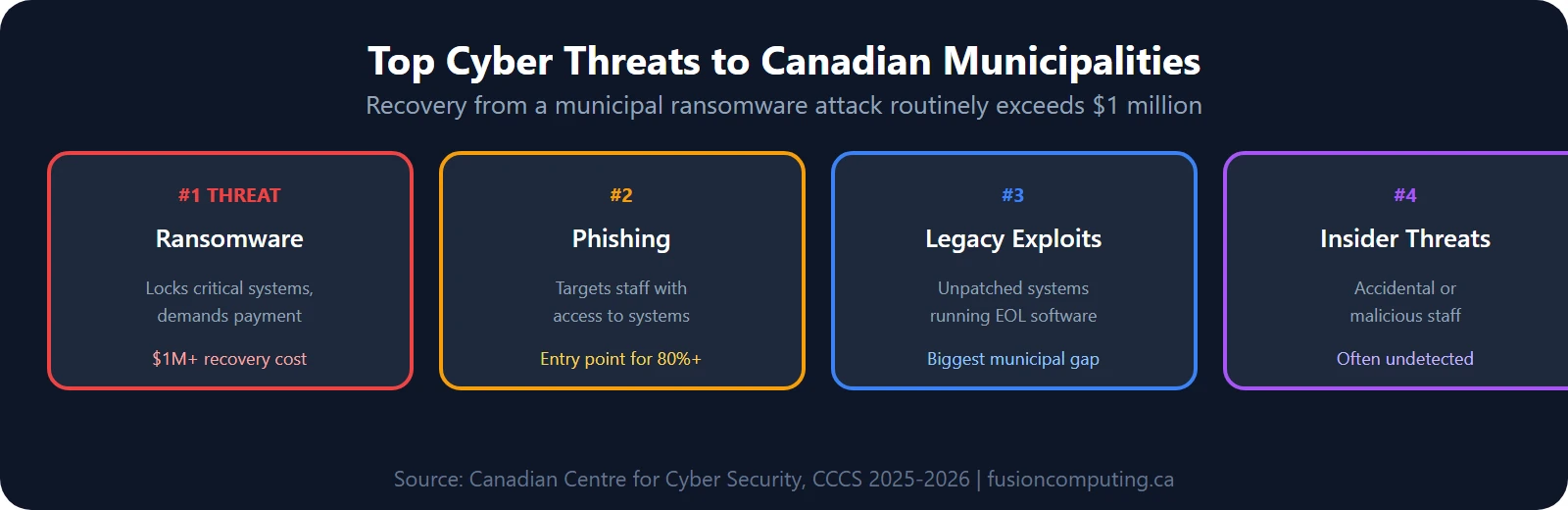
Municipal cybersecurity refers to the protection of local government IT systems, citizen data and critical infrastructure from cyberattacks. Canadian local governments are high-value targets because they hold sensitive citizen data, manage critical services and often run legacy systems. Ransomware is the primary threat, with recovery costs routinely exceeding CA$1 million.
The Municipal Cybersecurity Crisis in Canada
According to the Canadian Centre for Cyber Security’s National Cyber Threat Assessment 2025-2026, ransomware is the top cybercrime threat facing Canada’s critical infrastructure. Municipal governments sit among the most frequently targeted organizations because a service outage creates immediate political pressure to pay. That assessment names the exact pattern this guide is built around.
Local governments are targeted because they hold large volumes of sensitive citizen data, often run legacy systems with known vulnerabilities, operate with limited cybersecurity budgets and cannot tolerate extended service disruptions. Ransomware attackers exploit this urgency, knowing municipal governments face public pressure to restore services quickly and may be more likely to pay.
Canada’s cities and towns are now prime targets for cybercriminals. In February 2024, the City of Hamilton suffered a ransomware attack that knocked out phone lines, transit fare systems and online services for weeks. The city refused to pay and has since reported recovery costs running into the tens of millions of dollars. It wasn’t an isolated incident.
The Canadian Centre for Cyber Security reports that local government agencies face escalating threats: ransomware, data theft, critical infrastructure attacks and operational disruptions. Unlike federal agencies with dedicated security budgets, local governments juggle competing priorities with IT staff stretched thin. Water treatment facilities, 911 systems, property tax databases and permit systems all depend on aging infrastructure vulnerable to attack.
The attack surface is massive. Most of these organizations run legacy systems on unsupported software, host on-premises servers that rarely receive patches, lack real-time threat monitoring and depend on staff without formal cybersecurity training. Budget cuts mean towns with 50,000 residents often employ 1 IT person managing everything from email to critical infrastructure.
Why Municipal Governments Are Under Attack
Statistics Canada’s Canadian Survey of Cyber Security and Cybercrime (2024 release) found about 1 in 6 Canadian businesses were impacted by a cyber security incident in 2023. Total recovery spending doubled between 2021 and 2023. Public administration consistently reports above-baseline impact, which is exactly why attackers keep returning to town halls.
Canadian municipalities control critical infrastructure, hold large volumes of citizen data and often operate legacy SCADA systems with minimal security oversight, making them high-value, low-resistance targets. Ransomware has disrupted water treatment, emergency dispatch and payroll processing in at least 7 publicly disclosed Canadian municipal incidents since 2019. The combination of operational impact and political pressure to pay makes them a preferred target for organized threat actors.
Municipalities represent soft targets with high-value assets and cybercriminals exploit a simple calculus:
- Local governments hold sensitive citizen data: property records, business licences, personal information.
- They control critical infrastructure: water, transit, utilities, 911 dispatch.
- They typically lack the security maturity of larger enterprises, leaving a brutal choice between paying ransoms and losing essential services.
The Canadian Anti-Fraud Centre logs hundreds of millions of dollars in reported losses every year, much of it from invoice-redirect and wire-fraud schemes that disproportionately hit finance staff at municipalities and conservation authorities. Attack groups also target municipal SCADA and industrial control systems managing water treatment, sewage and electrical grids, where a successful breach can threaten public health. A corporate breach affects shareholders; a municipal compromise endangers residents.
Financial pressure compounds the problem. A mid-sized municipality spends CA$5 million to CA$15 million annually on IT operations, so new cybersecurity spending means deferred road repairs or delayed facility upgrades. Decision-makers routinely underestimate breach costs, which run well into the millions once ransom demands, recovery, notification and reputational damage are tallied.
Legacy Systems and SCADA: The Hidden Risk
The Canadian Centre for Cyber Security’s baseline cyber security controls for small and medium organizations define the starting set for exactly this situation. The set spans MFA, patching, backup testing and incident response sized for organizations that cannot staff a full security team. For municipal OT environments, the baseline pairs with segmentation that keeps SCADA reachable only through monitored paths.
Most Canadian municipalities run systems installed 10 to 15 years ago. These legacy platforms have no security patches available; vendors discontinued support years ago. SCADA and industrial control systems managing water treatment exemplify this risk: they were designed for reliability rather than security and often lack encryption or authentication mechanisms.
Take water infrastructure: a SCADA system managing treatment chemicals can’t be taken offline for updates, so cities must choose between security and operational continuity. Attackers know this. In February 2021, an intruder accessed the water treatment plant in Oldsmar, Florida and briefly raised sodium hydroxide dosing roughly 100-fold before an operator caught it. There was no ransom demand. The target was the chemistry itself.
I still walk council members through the Oldsmar timeline because it reframes patching as a public-health duty.
Managed cybersecurity providers specializing in municipal infrastructure understand these constraints. They implement air-gapped monitoring, network segmentation separating SCADA from corporate IT and vulnerability assessment protocols that don’t disrupt operations. CIS Controls v8.1 includes specific guidance for operational technology (OT) environments that municipalities should adopt immediately.
Ransomware: The Immediate Threat
Per CISA’s multifactor authentication guidance, enabling MFA makes an account 99% less likely to be compromised. That makes it the highest-impact control a municipal IT team can deploy this quarter. Most municipal ransomware still starts with a phished or brute-forced credential, not an exotic zero-day.
Ransomware is the primary threat facing Canadian municipalities. Attack groups like LockBit and BlackCat have specifically targeted public sector organizations. Recent variants encrypt critical files, steal sensitive data and threaten to publish it unless municipalities pay six-figure ransoms within 72 hours.
The pressure is immense. A municipality can’t function without access to tax systems, permit databases or payroll platforms and attackers know payment is often faster than a 3-week rebuild. Some insurers pay ransoms to minimize downtime, though the practice is controversial and restricted in some jurisdictions. In my incident debriefs, the pressure to pay peaks around hour 36.
The solution we deploy is a multi-layered defense:
- Endpoint protection on all devices, with EDR on servers and admin workstations.
- Email security filtering out malicious attachments before staff see them.
- Network segmentation isolating critical systems from office IT.
- Regular backups stored offline and immutable.
- Staff training to recognize phishing.
Cybersecurity assessments should specifically identify ransomware vectors in your network.
CIS Controls v8.1 for Municipal Government
The Center for Internet Security’s CIS Controls v8.1 (2024 update) organizes 18 controls into 3 Implementation Groups. IG1’s 56 foundational safeguards are the recognized floor for any organization handling citizen data. Insurers and auditors increasingly reference IG1 by name in municipal questionnaires, which makes it the natural budget anchor.
The Center for Internet Security (CIS) developed Controls v8.1 as a prioritized framework for government cybersecurity. Municipalities should adopt the 18 controls in sequence, starting with Implementation Group 1: asset inventory, data protection, account management, email filtering, endpoint detection, incident response and supply chain management.
CIS Controls emphasize quick wins achievable even with limited budgets:
- Control 1 (asset inventory) costs little but prevents attackers from exploiting systems you didn’t know you owned; many municipalities discovered forgotten servers during breaches.
- Control 5 (account management) eliminates shared passwords and default credentials.
- Control 9 (email and web browser protections) shuts the door most municipal ransomware still walks through.
The asset list is the first thing I check on any new municipal engagement.
Two exposures are worth measuring before anything else: how long internet-facing systems wait for a patch, and how many vendor remote-access accounts are still live. Both are cheap to check.
Implementation should be phased. Year 1 focuses on foundational controls 1 through 6. Year 2 adds detective controls (monitoring and incident response). Year 3 targets advanced controls for threat hunting and supply chain security. This approach fits municipal budgets and builds security maturity progressively. Data security and compliance frameworks should align with CIS Controls from the start.
“Our insurer’s renewal questionnaire went from a 6-week scramble to a single meeting. Fusion handed us the MFA coverage report, the last restore-test date and the incident response runbook in one evidence pack and the underwriter accepted it without follow-up.”
Building an Incident Response Plan for Municipalities
The Canadian Centre for Cyber Security’s incident response plan guidance (ITSAP.40.003) recommends documenting roles, escalation paths and communication templates before an incident, then rehearsing them at least annually. For municipalities the guidance carries extra weight: public communication duties and provincial breach notification obligations start running on day 1.
Municipal incident response requires specialized planning. Standard corporate playbooks don’t account for public communication requirements, stakeholder notification laws under MFIPPA and critical infrastructure considerations. An incident response plan should define clear roles, escalation procedures and communication templates.
Key components of a municipal plan (the checklist I run in every tabletop):
- Designate an incident commander with authority to make decisions, plus a named alternate.
- Establish a war room for coordination and document all systems and data ownership.
- Create notification templates for press, public and the privacy commissioner.
- Identify backup vendors in case your MSP is compromised.
- Rehearse annually with tabletop exercises.
In my experience running municipal tabletops, the failure point is almost never technical. Many municipalities discovered during actual breaches that nobody had authority to make critical decisions at 2 a.m. on a Saturday. Name the decision-maker in writing, name an alternate and give both a printed copy of the plan that doesn’t live on the network that just got encrypted.
Modern approach: implement endpoint detection and response (EDR) tools to spot breaches in hours rather than months. The earlier you catch an attack, the less data walks out the door and the lower the recovery bill. EDR also preserves the forensic trail law enforcement and insurers will ask for within the first 72 hours.
Cyber Insurance and Financial Protection
IBM’s Cost of a Data Breach Report (2025) puts the global average breach at US$4.44 million. Public-sector incidents carry costs the report can’t capture: service outages, council time and citizen trust. Insurers price accordingly and municipal premiums have climbed steeply since the 2019-2024 wave of Canadian municipal ransomware disclosures.
Municipal cyber insurance has become essential, though policies vary dramatically. Coverage should include:
- Ransomware response (where legal) and recovery costs.
- Business interruption and notification expenses.
- Forensic investigation.
Insurance companies now require documented security practices, creating accountability for CIS Controls implementation.
However, insurance isn’t a replacement for prevention. Insurers increasingly deny claims over basic failures:
- Unpatched systems and missing backups.
- Weak passwords or lack of MFA.
Policies also carry high deductibles (CA$50,000 to CA$250,000) and incident response requirements that override your internal plans.
Budget for a mix: insurance for catastrophic losses, and my advice is to put the primary focus on prevention through network security testing, regular vulnerability assessments and staff training. Insurance may cover 60% to 70% of direct costs, but it won’t restore public confidence or prevent service disruption during recovery.
Managed IT Services: Essential for Municipal Security
Canada’s National Cyber Security Strategy leans on partnerships between government and the private sector precisely because most public bodies cannot staff around-the-clock security operations alone. For a municipality, a managed provider is how 24/7 detection, patching and response become an affordable line item instead of 3 unfilled job postings.
In our experience, few municipalities can afford a dedicated CISO (Chief Information Security Officer). Managed IT service providers fill this gap: a qualified MSP handles patch management, monitoring, incident response and threat hunting. For municipalities, this transforms IT from a cost centre into a protection system.
What to look for in a provider:
- Municipal experience and CISSP-led personnel.
- CIS Controls alignment and 24/7 monitoring capability.
- Documented incident response procedures and provider-held cyber insurance.
Managed IT services should include regular assessments, staff training, security awareness programs and vendor management to verify contractors don’t introduce vulnerabilities.
The MSP model also fixes the budget math. Instead of hiring a full-time security analyst (CA$120,000+ annually), municipalities buy managed IT support from CA$185 per user per month, with most environments landing near CA$230 once 24/7 monitoring and compliance reporting are included. Cybersecurity-focused packages typically run CA$185 to CA$230+ per user per month.
Fusion Computing structures municipal engagements exactly this way: a 1-hour priority response for critical incidents, CISSP-led governance and pricing that scales with seat count rather than crisis count. That predictability is what lets a 40-person town hall and a 400-person regional municipality plan on the same line item.
Related Resources
See what a managed security program actually covers for a municipal environment like yours.
Book a Municipal Cybersecurity Consultation
Action Steps: Building Resilience Today
Municipal leaders should take 3 immediate actions:
- Assess your current posture against CIS Controls v8.1.
- Establish an incident response team with clear authority.
- Engage a qualified municipal cybersecurity services provider.
A gap analysis reveals which controls you’re missing, informs budget requests and turns staff into your first line of defense. Don’t wait for a breach to discover the gaps.
Ready to benchmark your municipality against CIS Controls v8.1?
Frequently Asked Questions: Municipal Cybersecurity Explained
Why are Canadian municipal governments such frequent ransomware targets?
Municipalities run a uniquely broad attack surface across water utilities, transit, permits, libraries, payroll and 911 dispatch, often on legacy systems with limited segmentation. The Canadian Centre for Cyber Security flags municipal governments as priority targets because service outages create immediate political pressure to pay. Constrained IT budgets, shared identity stores across departments and procurement cycles measured in years compound the exposure.
What recent Canadian municipal cyberattacks should councils learn from?
The City of Hamilton was hit by ransomware in February 2024 and took months to restore phone systems, transit fare processing and online services. The Town of St. Marys event in July 2022, Stratford in 2019 and Saint John, New Brunswick in 2020 all show the same pattern: legacy authentication, delayed patching and weak backup isolation. Councils that run after-action reviews of these incidents tend to fund controls faster than peers.
What cybersecurity framework should a Canadian municipality adopt?
Start with the Canadian Centre for Cyber Security baseline controls for small and medium organizations, layered with CIS Controls v8.1 and the NIST Cybersecurity Framework where insurer questionnaires require it. Expectations from the Information and Privacy Commissioner of Ontario for MFIPPA and PHIPA records and from the OIPC in British Columbia for FIPPA records, can be mapped into the same control register. A single audit cycle then satisfies multiple obligations.
How much does municipal-grade cybersecurity cost per user?
Fusion Computing prices managed IT support for municipalities from CA$185 per user per month, with most municipal environments landing near CA$230 per user per month once 24/7 monitoring and compliance reporting are included. Cybersecurity-focused packages typically run CA$185 to CA$230+ per user per month. Pricing scales with seat count, which lets a 40-person town hall and a 400-person regional municipality budget on the same predictable line item.
What is SCADA and why is it a municipal cybersecurity concern?
SCADA (Supervisory Control and Data Acquisition) systems manage critical infrastructure like water treatment, sewage and electrical grids. Many were installed 10 to 15 years ago, designed for reliability rather than security and lack modern authentication. An attacker who compromises SCADA could disrupt water service or alter chemical dosing, so municipalities need network segmentation and monitoring that does not interrupt operations.
Should municipalities pay ransoms or rebuild their systems?
Payment should be a last resort. Insurers and legal counsel must be consulted before any ransom decision and payment is restricted in some jurisdictions. The stronger position is prevention: offline immutable backups, EDR tools that detect intrusions within hours and a rehearsed incident response plan so recovery does not depend on attacker cooperation. The City of Hamilton refused to pay in 2024 and recovered on its own timeline.
What should a municipality look for in a managed IT provider?
Look for municipal experience, CISSP-led governance, CIS Controls v8.1 alignment, 24/7 monitoring, documented incident response procedures and provider-held cyber insurance. Fusion Computing has delivered CISSP-led managed IT and cybersecurity from its Dundas office since 2012, serving Toronto, Hamilton and Metro Vancouver with a 1-hour priority response commitment.
Do Canadian municipalities have legal obligations for cybersecurity?
Yes. Municipalities in all 10 provinces must protect records under provincial access and privacy laws such as MFIPPA in Ontario and FIPPA in British Columbia and health-adjacent records fall under PHIPA. Privacy commissioners increasingly expect documented incident response capability and breach notification readiness and a reportable incident can trigger parallel obligations to the provincial commissioner, cyber insurers and in some cases the federal Privacy Commissioner.